LISA Pathfinder is designed to demonstrate that free particles follow geodesics in space-time. It will do this by tracking two test masses in free fall using very precise laser interferometry. The spacecraft faced the challenge of keeping the test masses safe during the launch, whilst then being able to keep them in space with no external forces acting on them.
The distance between the test masses on board the spacecraft is too small to detect gravitational waves, but it is designed to show the technologies needed for a future mission that would be large enough to make the effects of a low-frequency gravitational wave measurable.
The mission carries the LISA Technology Package including inertial sensors, interferometric readout, payload computer and diagnostic system – provided by European companies, research institutes, and the European Space Agency; and the Disturbance Reduction System which is testing technology for NASA and consists of a processor running drag-free control software, and micro-Newton colloidal thrusters.
LISA Pathfinder ready for launch
The spacecraft was launched aboard a Vega rocket to a parking orbit around Earth. It will use its own propulsion module to travel on to the first Sun-Earth Lagrange point, L1. The journey and calibration phases will take a total of about three months. The European Space Agency intends to fly a large mission dedicated to the gravitational Universe as the third large mission of the current Cosmic Vision programme. The expected launch is in 2034.
The GCT prototype is first CTA telescope prototype equipped with an operational camera. It uses high-speed digitisation and triggering technology capable of recording images at a rate of one billion frames per second and sensitive enough to resolve single photons. To detect the short flashes of light produced by gamma rays as they hit the Earth’s atmosphere, the telescope’s camera has to be about a million times faster than a DSLR camera.
The telescope uses the Schwarzschild-Couder dual-mirror optical design, giving it good image quality over a large field of view and making it lighter than a single-mirror system.
The GCT is one of CTA’s small size telescopes (SSTs) and will cover the high end of the CTA energy range, between about 5 and 300 TeV (tera-electronvolts). Around 70 SSTs are needed to make sure the array is sufficiently sensitive at these enormous energies. Other small size telescopes are being prototyped and tested in Italy and Poland.
The AugerPrime symposium held on 15-16 November 2015 saw the signing of a new international agreement for the operation of the Pierre Auger Observatory for the exploration of cosmic rays until 2025. Collaborators and science funding agency representatives gathered in Argentina to sign the agreement, which will allow for new scintillation detectors to be added to the 1660 existing detectors, as well as faster and more powerful electronics.
Astrid Chantelauze, science outreach manager of the Helmholtz Alliance for Astroparticle Physics and Marie-Noëlle Rolland, freelance graphic designer, created a blog for their attendance at AugerPrime.
There is five times more dark matter in the Universe than “normal” matter, the atoms and molecules that make up all we know. Yet, it is still unknown what this dominant dark component actually is. Today, an international collaboration of scientists inaugurated the new XENON1T instrument designed to search for dark matter with unprecedented sensitivity, at the Gran Sasso Underground Laboratory of INFN in Italy.
Dark matter is one of the basic ingredients of the Universe, and efforts to detect it with laboratory-based experiments have been ongoing for decades. However, until today dark matter has been observed only indirectly via its gravitational interactions – the interactions that govern the dynamics of the Cosmos at all length-scales. It is expected that dark matter is made of a new, stable elementary particle which has so far escaped detection. About 100,000 dark matter particles are expected to pass through an area of 1 cm² per second. The fact that these particles have not yet been directly detected puts stringent constraints on their tiny interaction probability with the atoms of ordinary matter. It also implies that more sensitive instruments are required to find the rare signature of the dark matter particle. The international XENON Collaboration, consisting of 21 research groups from the United States, Germany, Italy, Switzerland, Portugal, France, the Netherlands, Israel, Sweden and United Arab Emirates, celebrated the inauguration of their new XENON1T instrument today, which will search for dark matter with unprecedented sensitivity.
The event took place at the Gran Sasso National Laboratory of the Italian National Institute for Nuclear Physics (INFN-LNGS), the largest underground laboratory in the world for astroparticle physics. The inauguration was attended by the XENON scientists along with guests from funding agencies as well as journalists and colleagues. About 80 visitors were able to join the ceremony directly at the experimental site in the 100m long, 20m wide and 18m high hall B of LNGS, which is itself below 1400m of rock. Here, the new XENON1T instrument is installed inside a 10m-diameter water tank to shield it from radiation which originates from the environment. Even more guests followed the introductory presentations in the LNGS auditorium, where Elena Aprile, Professor at Columbia University (New York) and founder of the XENON project, illustrated the evolution of the XENON program from the early beginnings with a 3kg detector 15 years ago to the present-day instrument XENON1T with a total mass of 3500kg.
Fighting against radioactivity
XENON1T employs the noble gas xenon as the dark matter detection material, which must be made ultra-pure and cooled down to –95°C to make it liquid. The large-mass instrument features an extremely low radioactive background in order to be able to identify the rare events from dark matter interactions. For this reason, the XENON scientists have carefully selected all materials used in the construction of the detector, ensuring that their intrinsic contamination with radioactive isotopes meets the experiment’s low-background strict requirements.
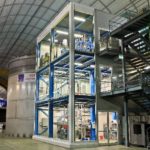
The XENON1T detector measures the tiny flashes of light and charge which are generated when a particle interacts with the xenon. The scientists use this information to reconstruct the position of the particle interaction within the detector, as well as the deposited energy and whether the interaction may have been induced by dark matter. The light is observed by 248 sensitive photosensors, which are each capable of detecting even single photons. A vacuum-insulated double-wall cryostat, essentially a gigantic version of a thermos flask, contains the cryogenic xenon and the dark matter detector. The xenon gas is cooled down and purified in the three-story tall XENON building, a fancy installation with a transparent glass facade right next to the water tank, allowing visitors to actually see what the scientists are doing inside. A gigantic stainless-steel sphere equipped with pipes and valves is installed on the ground floor. It can accommodate 7.6 tons of xenon in liquid and gaseous form, more than two times the capacity needed for XENON1T. This will allow the collaboration to swiftly increase the sensitivity of the experiment by using a larger mass detector in the near future.
Aiming for a dark matter detection
Once fully operational, XENON1T will be the most sensitive dark matter experiment in the world. The detector installation has been completed just a few days ago and the first tests of its performance have already been started. The first science results are expected early 2016, as only one week of good data is sufficient to yet again take the lead in the field. The design goal of the experiment will be reached after two years of data taking, as the collaboration explains in a detailed sensitivity study published at the same time as the inauguration. The ultimate goal is the detection of the dark matter particle. Still, even if there are only some hints found after two years of operation, the XENON collaboration will be in an excellent position to move forward, as the next phase of the project, XENONnT, is already being prepared. It will largely use already existing infrastructure, and will increase the sensitivity to dark matter by another order of magnitude.
The ESA mission Planck has set a very high standard in European research on the cosmological microwave background delivering the definitive map of temperature fluctuations. These measurements together with other measurements, e.g. the discovery of Higgs at LHC nurture the hope of a fundamental theory addressing the formation of the Universe at all scales from the smallest to the largest.
Furthermore, Planck together with other CMB measurements on ground and large surveys using telescopes opened the possibility of new breakthroughs in the CMB domain, including the mapping of the B-polarisation. This will give access to the parameters of inflation and the neutrino mass, the correlation of CMB with large scale structures as well as the distortions of the blackbody spectrum, opening access to phase transitions and other events before recombination.
It is currently believed that the next space mission will happen at the earliest in the late twenties-early thirties and it should be planned with the same ambition that determined the design of Planck, that is: give definitive measurements. Till then the European CMB community needs to develop both intermediate measurements on ground or using balloons and the technology that would permit ultimate sensitivities.
APPEC and ASTRONET organize the meeting “Towards the European Coordination of the CMB programme” in August 31-September 1, 2015 in Florence. The meeting will gather both principal investigators and agency representatives attempting to set the conditions and chart the first steps towards European coordination on the ground and sub-orbital missions, review and prepare future collaboration in the detector side, discuss similar efforts in other parts of the world, prepare the proposals to future mission calls of ESA.
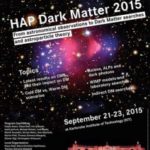
Joint workshop Astroparticle Theory and Dark Universe
21-23 September 2015, Karlsruhe Institute of Technology, Germany
This meeting follows the HAP DM 2013 meeting, addressing recent results and developments in Dark Matter search. The workshop will be organised along plenary overview talks by senior scientists, with the additional possibility for young researchers to present their work in short presentations.
HAP DM 2015 will have overview talks on the following topics:
CMB and its impact on DM: Planck results focussing on consequences for WIMP DM
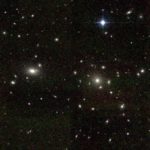
CDM vs. WDM scenarios: N-body simulations with LCDM parameters: general overview and special results on dwarf galaxies; Simulations of galactic structures with warm DM; Astrophysical observations of dwarf galaxies/ dwarf galaxy surveys; Searches for DM annihilation in dwarf galaxies; Production of Sterile Neutrino dark matter; Observation of a 3.5keV line from X-ray observations of galaxy clusters – evidence for sterile neutrinos?
WIMP models and (laboratory) searches: WIMP interactions in EFT and simplified models; LHC DM search: results and perspectives; Asymmetric Dark Matter; Two-Component Dark Matter; SUSY NMSSM WIMPs; Direct searches for WIMPs, challenges & perspectives with liquid noble gas detectors; Direct searches for WIMPs, challenges & perspectives with cryogenic bolometers
Axions, ALPs and dark photons: Phenomenology of dark photons and ALPs; The experimental search for axions and ALPs
Indirect DM searches: Modelling of astrophysical foreground; Update on Fermi-LAT & the case for a 1-3 GeV excess in GC data; Positron excess, the search for nuclei and prospects with AMS-02; Searching for a neutrino signal from DM annihilation in IceCube and SuperK
Program Committee:
Gisela Anton (ECAP Erlangen), Klaus Eitel (KIT), Iris Gebauer (KIT), Josef Jochum (Kepler Center Tübingen), Michael Klasen (WWU Münster), Lutz Köpke (JGU Mainz), Marek Kowalski (HU Berlin, DESY Zeuthen), Gernot Maier (DESY Zeuthen), Uwe Oberlack (JGU Mainz), Martin Pohl (U Potsdam, DESY Zeuthen), Thomas Schwetz-Mangold (KIT), Günter Sigl (U Hamburg), Christopher Wiebusch (RWTH Aachen)
Local Organisation:
Klaus Eitel, Marie-Christine Kauffmann, Thomas Schwetz-Mangold