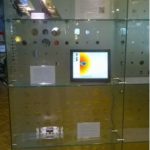
A recently installed small exhibition describing the activities of the GRAPPA institute is found on the first floor of the UvA Science building at Science Park 904.
The top shelf contains an overall description of GRAPPA and some public science book by our members. The third shelf from the top currently has a LEGO model for the ATLAS detector at LHC, while the bottom shelf contains some theses from GRAPPA students.
The future of the research with space-borne and ground-based experiments dedicated to the study of cosmic rays, especially gamma-rays, will be discussed, looking in particular to its potential for multi messenger astrophysics and for discoveries in the sector of physics in extreme conditions, and to new installations in the Northern and in the Southern hemispheres.
This workshop is done in La Palma, which hosts the Observatorio de Roque de Los Muchachos (ORM), where gamma-ray astrophysics is protagonist since the last 30 years, with HEGRA and MAGIC in particular. ORM is also one of the candidate sites for CTA North and the site where the prototype of the Large Size CTA Telescope (23 m) will be installed. A guided tour of the experimental installations will be organised within the workshop.
This workshop is dedicated to the memory of Eckart Lorentz, one of the fathers of experimental cosmic-ray physics with photons in the TeV region.
Chairs: De Angelis, Alessandro
Antonelli, Angelo
Mirzoyan, Razmik
The objective of the three-day “AMS Days at CERN” is to exchange ideas and experiences with the world’s leading theoretical and experimental physicists. This exchange will lead to a better understanding of the implications of AMS results (published and to be published) and their relevance to some of the key experiments as well as the future course of cosmic ray physics.
When : Thursday, 12 March from 2.30 to 3.30pm (CET) – Open seating as from 2.15pm
Speakers : CERN’s Director General, Rolf Heuer and Director of Accelerators, Frédérick Bordry, and representatives of the LHC experiments
CERN is pleased to invite you to the above press briefing which will take place on Thursday 12 March, in the Globe of Science and Innovation, 1st floor, from 2.30 to 3.30pm (CET).
The Large Hadron Collider (LHC) is ready to start up for its second three-year run. The 27km LHC is the largest and most powerful particle accelerator in the world operating at a temperature of -217 degrees Centigrade and powered to a current of 11,000 amps. Run 2 of the LHC follows a two-year technical stop that prepared the machine for running at almost double the energy of the first run. After substantial consolidation and improvements the LHC will restart at an energy of 6.5 TeV per beam, which will open up a new window for discovery – collisions at a total energy of 13 TeV are expected late Spring.
CERN General Director Rolf Heuer, the Director of Accelerators Frédérick Bordry, and the LHC experiment representatives will take questions regarding the LHC second three-year run, focussing on the technical challenges in preparing for Run 2, and on the new discovery potential.
LHC experimental physicists and theorists will be at your disposal for interviews at the end of the briefing. The highlight of the machine’s successful first run was the discovery by the ATLAS and CMS experiments of the long-sought Higgs boson.
CERN, the European Organization for Nuclear Research, is the world’s leading laboratory for particle physics. It has its headquarters in Geneva. At present, its Member States are Austria, Belgium, Bulgaria, the Czech Republic, Denmark, Finland, France, Germany, Greece, Hungary, Israel, Italy, the Netherlands, Norway, Poland, Portugal, Slovakia, Spain, Sweden, Switzerland and the United Kingdom. Romania is a Candidate for Accession. Serbia is an Associate Member in the pre-stage to Membership. India, Japan, the Russian Federation, the United States of America, Turkey, the European Union, JINR and UNESCO have Observer Status.