News

Gravitational Wave detection GW190521 – an unexpected discovery

Interview about the Gravitational Wave GW190521, detected by Virgo and LIGO, with Giovanni Losurdo On 2 September the Virgo and LIGO collaborations published their discovery of the most massive Black Hole ever measured with Gravitational Waves. This is another huge milestone in the field of Gravitational Wave observations. The scientists observed the merging of two

Gravitational Wave detection GW190521 – an unexpected discovery Read More »

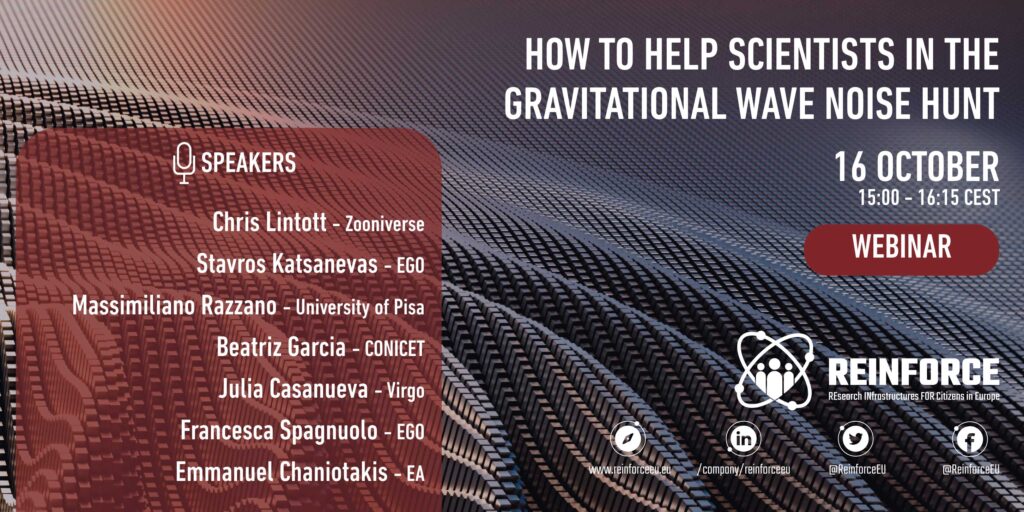
REINFORCE webinar – How to help scientists in the Gravitational Wave noise hunt

On 16 October REINFORCE (Research Infrastructures FOR citizens in Europe) organizes a webinar for potential citizen scientists, Gravitational Wave Astronomy researchers and academics, members of the physics and astronomy community and educators. The webinar aims to give an overview of the first of REINFORCE Large Scale Citizen Science demonstrators which are the key vehicles that

REINFORCE webinar – How to help scientists in the Gravitational Wave noise hunt Read More »

Gravitational Wave Probes of Fundamental Physics – a cross-cutting initiative

Interview on Gravitational Waves Expression of Interest with Tetyana Galatyuk and Paolo Pani In response to the JENAS call the Gravitational Wave Community prepared an open Expression of Interest on “Gravitational Wave Probes of Fundamental Physics”. Already two weeks after the announcement, the list of endorses counted over 500 people. Tetyana Galatyuk and Paolo Pani,

Gravitational Wave Probes of Fundamental Physics – a cross-cutting initiative Read More »

CUPID-Mo: a new world leading limit for neutrinoless double beta decay of 100Mo

Neutrinoless double beta decay (0νββ) is a crucial process in particle physics and cosmology. It can be conceived as an inclusive test of “creation of leptons” (leptons are produced with no counterpart in terms of antileptons, and lepton number violation occurs) and, more generally, as “creation of matter” (particles are produced with no counterpart in

CUPID-Mo: a new world leading limit for neutrinoless double beta decay of 100Mo Read More »

CTA Prototype LST-1 Detects Very High-Energy Emission from the Crab Pulsar

Between January and February 2020, the prototype Large-Sized Telescope (LST), the LST-1, observed the Crab Pulsar, the neutron star at the centre of the Crab Nebula. The telescope, which is being commissioned on the CTA-North site on the island of La Palma in the Canary Islands and which just passed its Critical Design Review, was

CTA Prototype LST-1 Detects Very High-Energy Emission from the Crab Pulsar Read More »