The ESA/ESO SCIOPS workshop 2019 on “Cross Facilities Collaboration in the Multi Messenger Era” will be held from 19-22 November 2019 at the European Space Astronomy Centre (ESAC), ESA, Villanueva de la Cañada, Madrid, Spain.
With the observations of electromagnetic counterparts to gravitational wave events and to high-energy neutrinos, astrophysics has entered the multi-messenger era. New powerful survey facilities at different wavelengths are becoming reality and will hugely increase the number of potentially interesting targets in the next few years. A growing network of observatories is being made ready to follow up on exciting events. But the sheer number of expected follow-up targets and the complexities of collaboration and coordination among wide groups of researchers and different observatories poses many challenges to the existing means and ways of working.
At the same time, technology continues to make rapid advances, allowing for unprecedented interconnectivity, fast and interactive visualisation and new methods of machine-supported analysis for huge data sets. As the everyday experience of dealing with technology and information evolves, so do requirements on the organisations providing data to the scientific community and the general public.
This 4th ESA-ESO collaborative workshop will focus on the experiences gained in the last years in multi-mission, multi-wavelength and multi-messenger collaboration, on the challenges for the coming years and on ideas and approaches to tackle these challenges.
The 10th ET Symposium will be held from 11-12 April 2019 at Orosei, Sardinia, Italy, 30km away from the Sos Enattos Mine, one of the candidate sites of Einstein Telescope.
2019 is a crucial year for the ET. The 10th annual symposium will mark the official beginning of the ET international collaboration, with voting the statute of the collaboration and the public kick-off of the preparation of the ET proposal for the ESFRI roadmap update. At the meeting the science case of the future 3G network and the update of the ET conceptual design will be discussed.
A limited number of talks and posters will be accepted at the symposium. Young researchers are kindly and strongly invited to submit their proposal for a talk or a poster. Submission is expected to close the 15th of March 2019
The International School on Gravity from Earth to Space, 21-23 May, aims to bring together PhD students, Post Docs and young researchers from LISA and Earth interferometer communities who during three intense days will have the opportunity to follow a series of lectures on gravity, gravitational waves with a focus on detectors, data analysis techniques and astrophysical source science including electromagnetic and astroparticle observations. Discussions among students and lecturers will be encouraged being the location of the conference and of the social program the Hotel San Domenico just in front of the beautiful Ducal Palace in Urbino, Italy.
The theme for the First CTA Symposium is “Science opportunities with CTA” and will take place at the historical Teatro Duse in Bologna 6-9 May 2019 (https://www.cta-symposium.com). Through a combination of invited and contributed talks, as well as poster sessions, the meeting aims to gather the larger Multi-wavelength and Multi-messenger communities and set up new channels of communications and synergies among them and their results (preliminary programme available on the website). The call for contributed talks to this First CTA Symposium in now open, and covers the following areas of the field:
– Cosmic particle acceleration
– Compact objects and relativistic shocks
– Role of cosmic particles in galaxy evolution and star-forming systems
– Gamma rays as cosmic probes
– Fundamental physics
– Multi-wavelength and multi-messenger observations
– Additionally, any topic connected to the scientific possibilities of CTA
Registration for the First CTA symposium is now open. Participants can register online at http://www.cta-symposium.com/registration. Your registration will be confirmed by the workshop secretary as soon as the registration fee has been received. The workshop registration fee is 300 € before 5 April, 2019 and 350 € after this date. A special rate of 200 € (250 € after 5 April) is available for students.
Submit your abstract by sending your contribution to symposium-abstracts@cta-observatory.org – please make your submissions comprehensible to a broad astrophysical audience as some of the attendees may be unfamiliar with the specifics of your field.
The deadline to submit abstracts has been extended to March 10, 2019. The scientific organising committee (SOC) will consider the submission for inclusion in the preliminary programme and will notify the authors whether their contribution has been selected for an oral/poster presentation by March 29, 2019.
The school is primarily intended for PhD students. Since the number of participants is limited, applications from PhD students will therefore be favoured. Masters students and young postdocs are nonetheless welcomed to apply.
Lecture topics include: Classical solutions in Field Theory and applications, Statistics and introduction to Machine Lerning,BSM Landscape after LHC I and II runs, Neutrino Phenomenology,Neutrinos in Cosmology, Effective theories for dark matter, Perspectives in particle detection,Special lecture on Black Holes
Several tutorial sessions will be organized, where students will further discuss the topics covered in the lectures within an informal environment. Moreover, a poster session will take place during the school, students are thus encouraged to bring and present their own posters.
Students attending both the School and the Workshop may have a priority in being accepted to give a talk at the latter.
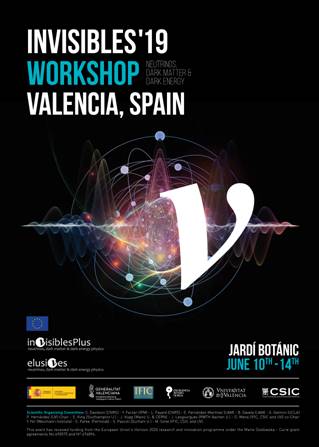
Early registration deadline is April 9th, 2019 (Please note that PhD students applying for a plenary talk + poster must register by May 1st, 2019) https://congresos.adeituv.es/invisibles19/
The focus of the workshop will be on the physics of the “Invisibles”:
Invisible particles: neutrinos, axions, WIMPs;
Invisibles at colliders: Beyond Standard Model searches
Invisibles in astrophysics and cosmology: dark matter searches, black holes, gravitational waves and the origin of Cosmic Rays
Talks are by invitation only, except for PhD students who are encouraged to apply for a brief plenary talk plus a poster presentation.
The school and workshop are the annual events of the European projects H2020 ITN “Elusives” (www.elusives.eu) and H2020 RISE “InvisiblesPlus” (www.invisiblesplus.eu), focused on Neutrino and Dark Matter physics and their connections, with emphasis on the role of symmetry relating matter and antimatter. They continue the thematic series that started in 2012 around the former network FP7 ITN “Invisibles” (www.invisibles.eu).
LIP, University of Minho, IDPASC and the COST action g2net are organizing a school on Data Science in (Astro)Particle Physics and Cosmology, targeted at PhD and MSc students, as well as at researchers from different areas, interested in learning about the use of modern data analysis tools. The school will be held in Braga, Portugal, from 25 to 27 March 2019, and will be followed by the symposium Data Science: Bridging Fundamental Research and Industry(28-29 March 2019), which aims to make the bridge between the academic and industry worlds.
The school will have theory and practical lectures, with a strong hands-on component. The students will be invited for a data challenge where gravitational waves data will be used for a classification problem. The COST action CA17137 – g2net: a network for Gravitational Waves, Geophysics and Machine Learning – will financially support the participation of some students and young postdocs in this school.
The symposium aims to show the potential of data science in modern society and to stimulate synergies between fundamental research and industry. Representatives from the academy and industry will present the current challenges in data analysis in an informal environment with plenty of time for discussions and networking.
From 18-22 March 2019 the Neutrino Telescopes Workshop takes place in Venice, Italy. The workshop dates back to 1988 when the first edition was launched. Latest discoveries and the fascinating future scenarios in topics that range from Neutrinos to Astrophysics and Cosmology are discussed. The 2019 edition will focus to the original argument of the workshop: Multimessenger Physics.
The XVIII International Workshop on Neutrino Telescopes is organized by the INFN Padova Unit and by the Physics and Astronomy Department of Padova University.
Registration is still open until March 8th, Poster Abstract Submission is open until February 22nd.
The aim of the School is to cover topics in both experimental and theoretical astroparticle physics. The program of the school will include three main lecture courses followed by tutorials, practical and discussion sessions, together with several separate lectures, special session for participants presentations and excursion to underground laboratories of the Baksan Neutrino Observatory. The School is addressed to advanced masters students, graduate students and postdocs working in astroparticle physics.
The key features of the school are:
* Three 6-lecture courses by leading experts (neutrino detection, machine learning, multimessenger astrophysics), supplemented by tutorials, practical work, more lectures and participants’ talks.
* Excursion to Baksan Neutrino Observatory underground labs (4800 mwe).
* Location in a national park close to Mt. Elbrus (5642), one of the “Seven Summits” of the World, with possibilities for skiing and hiking during long mid-day breaks.
* Low registration fee (325 EUR including full-board lodging, airport transfer, banquet and excursion) and fellowships covering the fee.
APPEC is organizing the Workshop on Observatory Synergies for Astroparticle Physics and Geoscience with the geoscientists of GEO-8 and the co-sponsoring of the Academia Europaea. The workshop will be held at the Institut de Physique du Globe de Paris (IPGP) on February, 11-12 2019 (afternoon to morning).
It will provide a venue for discussing the development of relatively recent and highly promising applications of astroparticle physics in the geosciences, including gravitational, muon, and neutrino imaging, innovative fiber-based monitoring systems, data collection in extreme environment, etc.
Furthermore, this workshop represents the ideal occasion for improving exchange and cooperation with geoscientists.
Details and the workshop program can be found here:
Rationale. The recent convergence between Geoscience and Astroparticle Physics. In the last years there appeared many areas of natural synergy between Geosciences and Astroparticle Physics. Earth and Astroparticle sciences share a mutual scientific culture based on common objects of study, methods and approaches. They both deal with complex natural systems at much larger scales than the human scale, need deployments of large sensor networks in sometimes very hostile environments (sea, desert, underground, space), use long series of precise observations acquired over a range of time scales. They develop models relying on the state of the art in fundamental physics, chemistry, earth sciences, biology, numerical and computer sciences. They finally use big data analysis and transfer and worldwide networking. In particular, some of the synergies concern:
Imaging (gravitational, acoustic, muon, neutrino)
Data collection in extreme environment
New technological means for parameter monitoring
Contribution to the understanding and forecasting of natural hazards
Aim and structure of the workshop. The main aim of the proposed workshop is to explore the possible common grounds and combine the scientific expertise of both fields, involving key PIs of the respective fields together, in order to promote original interdisciplinary research and education projects. The structure of the workshop will be as follows: There will be a series of short presentations by key PI’s on the possible synergies and the cases developed up to now, followed by a discussion and a closing meeting with organisations collaborating in APPEC and GEO-8, as well as other Geosciences and Astrophysics agencies. Common lines of action, regarding co-funding or common applications to European calls, and international collaborations will be explored. The workshop will also examine opportunities for future coordination during the last part of the H2020 (2018-2020) and the forthcoming Horizon Europe programs.
Organizing Committee:
Michel Diament (Institut de Physique du Globe de Paris)
Philippe Jousset (Helmholtz Centre GFZ)
Stavros Katsanevas (Director of EGO – European Gravitational Observatory)
Topic: Active and passive stabilization systems and sensors
The Astroparticle Physics European Consortium APPEC is inviting technology experts from industry and academia to the APPEC Technology Forum 2018 (ATF 2018) on Nov 12-13 2018 in Veldhoven, near Eindhoven in The Netherlands.
For the sixth year, ATF 2018 will provide the necessary framework for discussions among all the stakeholders fostering new R&D activities, improving existing technology and supporting current and emerging intra- and extra-field collaborations.
With the intention of laying the foundations for future cooperation involving industry and academia, this year the ATF 2018 will concentrate on the development of holders and positioning systems for high-stability setups, where vibrations can be detected with special sensors and then suppressed, extending to other forms of active and passive stabilization needed in many scientific experiments. This technology can have a wide range of applications, for example, where mirrors, magnets and detectors have to be precisely positioned, or temperature and pressure have to be accurately stabilised.
The fields of application are also numerous, ranging from astroparticle, particle and detector physics to geology, quantum mechanics and many other disciplines. The potential for innovative applications is large and we are convinced there will be the opportunity for an effective exchange of ideas and experiences among the participants.
ATF 2018 is taking place immediately before the Precision Fair 2018, at the same location which will provide even more opportunities for knowledge transfer and collaboration. The Fair is focused on development and production of high-tech components, modules and systems, aimed at meeting the ever increasing demands on shape, size and accuracy of fast precision positioning. Two sessions on the first day of the Fair will be dedicated to the achievements and future demands of precision technology in Big Science Projects.
Participants from CERN, the KATRIN experiment and Einstein Telescope (ET) community have already confirmed they will present their high-precision technology at the Forum. Register here to attend: https://indico.desy.de/indico/event/20154/registration/


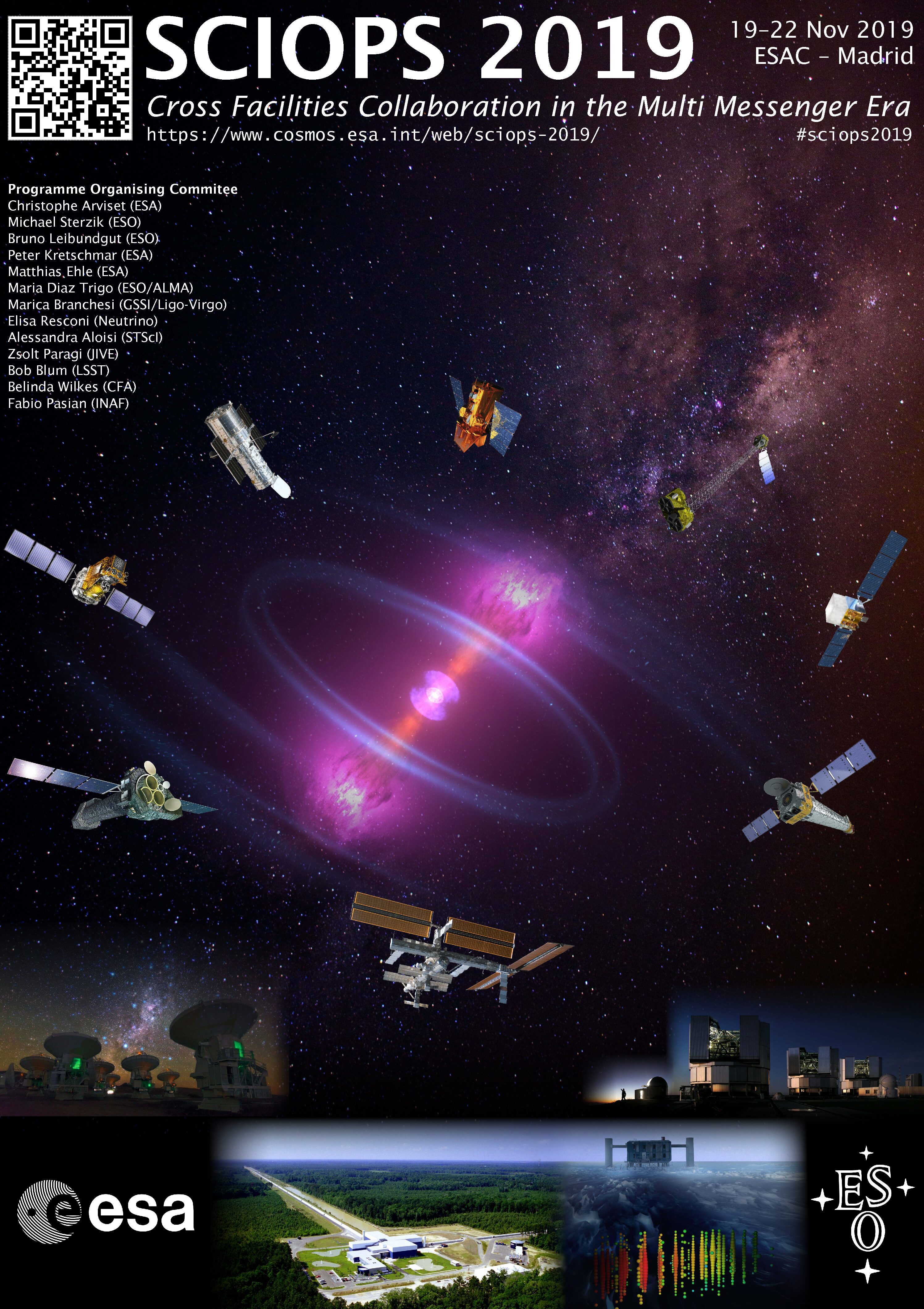
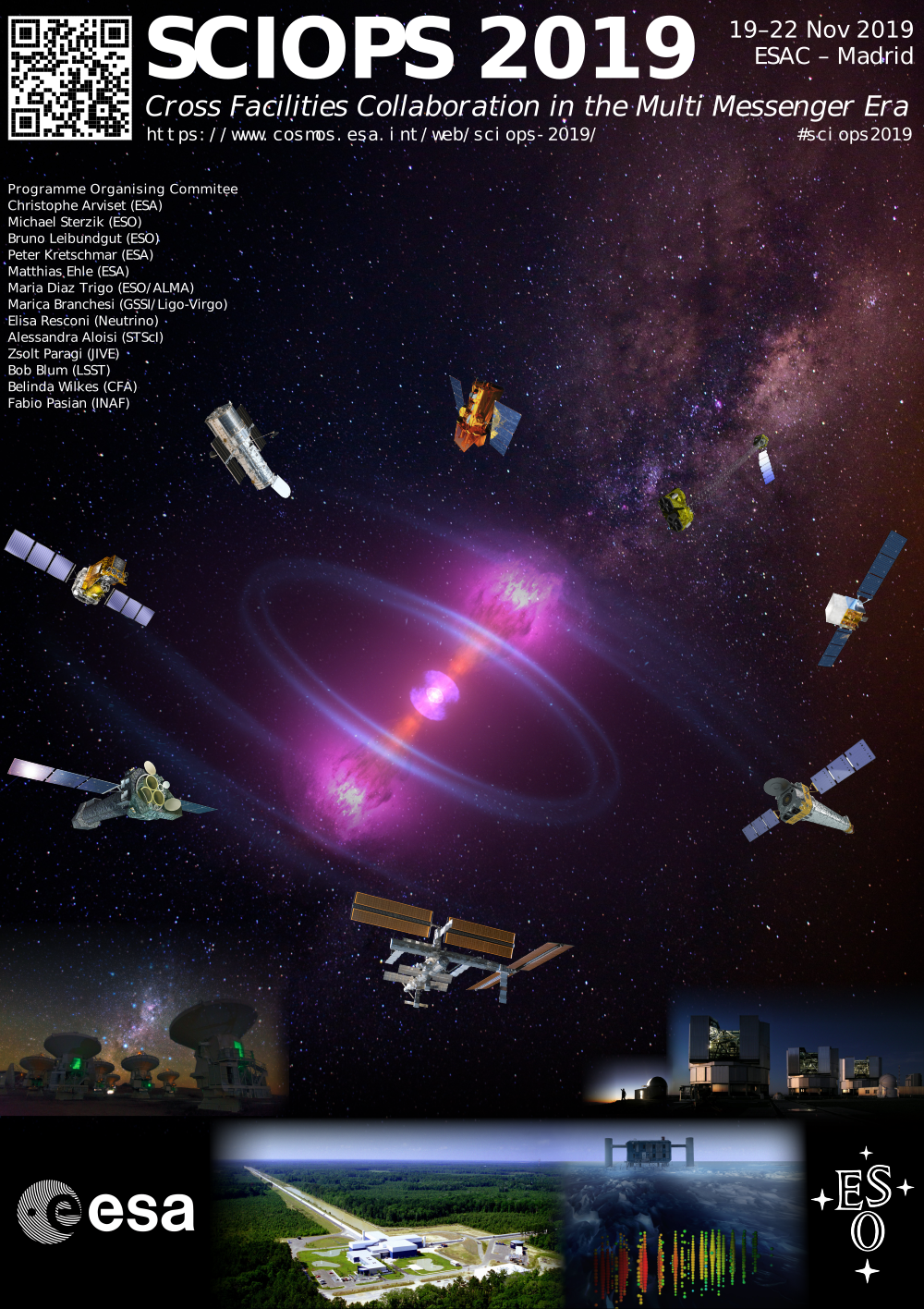 The ESA/ESO SCIOPS workshop 2019 on “Cross Facilities Collaboration in the Multi Messenger Era” will be held from 19-22 November 2019 at the European Space Astronomy Centre (ESAC), ESA, Villanueva de la Cañada, Madrid, Spain.

 Invisibles’19 School: The
  Invisibles’19 Workshop: The

 APPEC is organizing the Workshop on Observatory Synergies for Astroparticle Physics and Geoscience with the geoscientists of