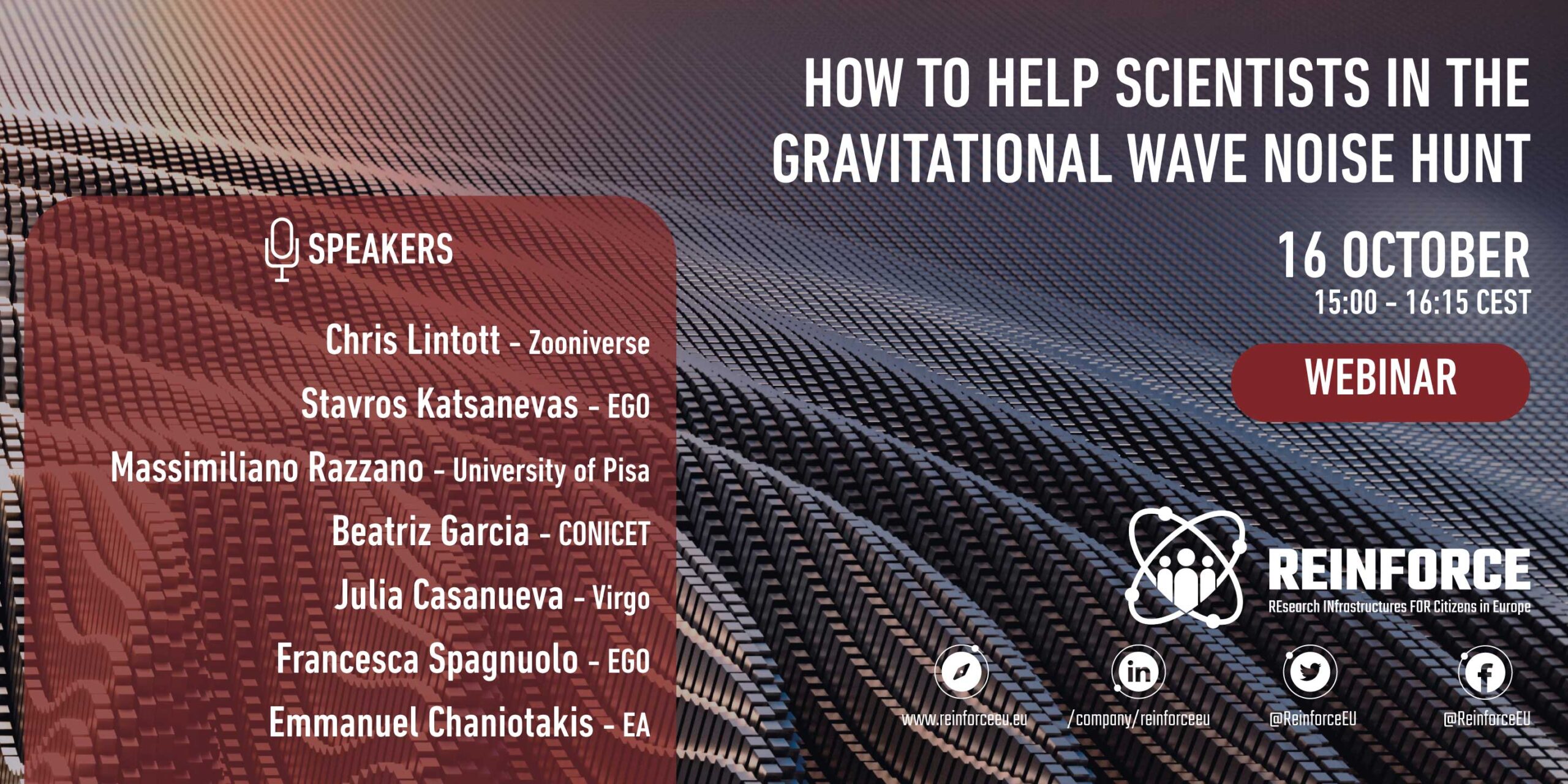
On 16 October REINFORCE (Research Infrastructures FOR citizens in Europe) organizes a webinar for potential citizen scientists, Gravitational Wave Astronomy researchers and academics, members of the physics and astronomy community and educators. The webinar aims to give an overview of the first of REINFORCE Large Scale Citizen Science demonstrators which are the key vehicles that the project will utilise in order to bring frontier science and society together, showcasing the issue that the citizens will be asked to help in solving, how this activity will be performed relying on Zooniverse resources and technologies, and how the sonification of data will allow to widen the spectrum of people potentially involved.
The sensitivity of Gravitational Waves detectors is limited by several types of noise, called glitches, whose presence affects the quality of the data. The glitches can have various origins, having a stationary nature (e.g. a noise signal with a stable frequency) or being transient on various timescales. In order to optimize and run the interferometers it is fundamental to identify the sources of noise and reduce or eliminate its origin.
In this framework, citizen scientists can play a fundamental role by looking at chunks of data and identify the presence of noise, creating the basis to train machine learning algorithms that will automatically recognize and isolate noise in GW data, thus providing a monitoring of the noise with an unprecedented detail. Citizen scientists’ support will be crucial also to isolate astrophysical signals that cannot easily be modeled with the general relativity equations, and whose shape is unknown, such as supernovae ones.
In REINFORCE, the citizen science activities will support the optimization of the Virgo detector, allowing citizens to learn the basics of GW detection techniques, and how the noise signals and GW signals look. One of the innovative aspects of the project is that it aims to include diverse and underrepresented groups in science, by providing them with tools to overcome specific barriers, such as the sonification of data for visually-impaired people.
A long-term workshop on experimental Astroparticle Physics will be held from 02 to 27 November 2020 at Institut Pascal in Orsay. This workshop is a continuation of the Paris-Saclay AstroParticle Symposium of 2019 on theoretical Astroparticle Physics.
The aim is to gather specialists of the field on the topics of High-Energy Astroparticle Physics including high-energy cosmic rays, gammas, neutrinos and gravitational waves with special emphasis on multi-wave length and multi-messenger studies. The workshop includes working sessions every day (only one informal discussion per day, and on Friday, a ‘conference’ format day with speakers). They intend to invite confirmed researchers accompanied by their students and/or postdocs to make working conditions as enticing as possible. The aim is to initiate/continue/finalise research projects in an inspiring environment.
The 9th edition of the Very Large Volume Neutrino Telescope Workshop (VLVνT-2021) will be held from 20th to 23th April 2021, in Valencia, Spain. The workshop provides an ideal forum to discuss the latest developments in neutrino astronomy together with progress on the technological and instrumentation aspects of current and future large scale detectors in water and ice. It brings together the main collaborations working on neutrino telescopes (ANTARES, IceCube, KM3NeT, GVD) and is sponsored by the Global Neutrino Network (GNN).
— CANCELLED/POSTPONED, please check the website of the event for further information —
RICAP-20 will be the eight edition of the RICAP Conference and will take place from June 30th to July 3rd, 2020 in Roma, Italy. The acronym stands for Roma International Conference on Astro-Particle physics, the Conference is entirely dedicated to the study of high energy cosmic rays and it is organized by the three public Universities of Roma (University “Roma Tre”, University “La Sapienza” and University “Tor Vergata”). These Institutions provide both theoretical and experimental contributions, and participate to major experimental projects in the field (AGILE, AMS, ANTARES, ARGO, Auger, CTA, Fermi, JEM-EUSO, KM3NeT, NEMO, PAMELA,…). The Conference is held every two years and in 2020 will be held at the Physics Department of the University “La Sapienza”.
The aim of the Conference will be to present and discuss some of the most relevant theoretical and experimental results in the field of high energy cosmic rays (gamma, neutrinos, charged cosmic rays). Special attention will be paid to the multi-messenger search for high energy cosmic rays sources, including gravitational wave searches. A special session will be dedicated to Dark Matter search. The Conference will give the opportunity to collect experimental results from presently operating experiments. Experiments in progress and future projects will be discussed, debating on the different features and on sensitivities. Particular relevance will be given to the discussion of the open questions in high energy Astroparticle Physics
— CANCELLED/POSTPONED, please check the website of the event for further information —
The 16th Patras Workshop on Axions, WIMPs and WISPs will be held in Trieste (Italy) from 20 to 26 June 2020. The nature and composition of Dark Matter and Dark Energy are two of the most pressing mysteries of frontier physics, and research in these fields is presently gathering increasing momentum and attracting the efforts of scientists from many international institutions. The “16th Patras Workshop on Axions, WIMPs and WISPs” is the latest event in an annual series of conferences, started in 2005 at CERN. This workshop is aiming to continue the rich and successful series, reviewing recent theoretical advances, laboratory experiments, novel ideas as well as astrophysical and cosmological results in the fields of axions, WIMPs and WISPs. Participation by young scientists is strongly encouraged.
— CANCELLED/POSTPONED, please check the website of the event for further information —
The 27th European Cosmic Ray Symposium (ECRS 2020) will be held in Nijmegen, the Netherlands from July 13th to 17th, 2020.
The European Cosmic Ray Symposium is covering the following topics in Astroparticle Physics:
Cosmic-Ray Physics, Gamma-Ray Astronomy, Neutrino Astronomy, Dark Matter Physics, Solar and Heliospheric Physics, Astroparticle Physics Theory and Models as well as Experimental Methods, Techniques, and Instrumentation.
The scientific program will include invited plenary talks, solicited presentations in parallel sessions, and poster sessions. There will be awards for the best posters.
— CANCELLED/POSTPONED, please check the website of the event for further information —
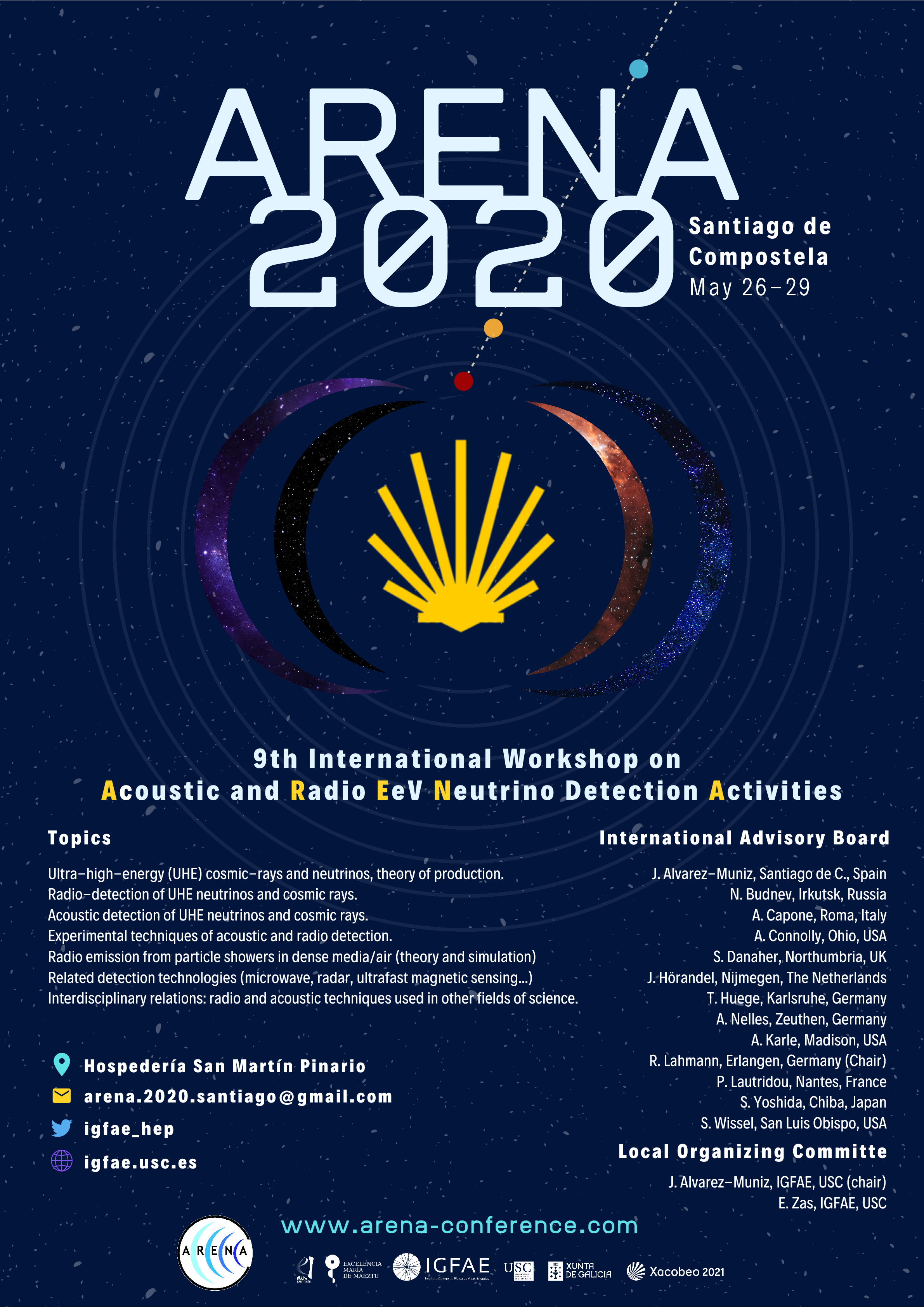
The 9th International Conference on Acoustic and Radio EeV Neutrino Detection Activities will be hosted at Monasterio San Martin Pinario, Santiago de Compostela on May 26 – 29, 2020. ARENA 2020 will be the 9th International Conference in a series of events bringing together experts in the use of acoustic and radio techniques for the detection of ultra-high-energy cosmic rays and neutrinos.
The new amazing discoveries reported from high-energy neutrino, gamma-ray and gravitational wave detectors have started the exciting era of multi-messenger astronomy, opening a new window to the most extreme universe.
ARENA 2020 is the major bi-annual event for scientists to pioneer, develop and consolidate techniques for ultra-high-energy particle detection, paving the way to the future.
The workshop covers the following topics, comprising theory, simulation, and existing and future experiments:
Ultra-high-energy (UHE) cosmic-rays and neutrinos, theory of production.
Radio-detection of UHE neutrinos and cosmic rays.
Acoustic detection of UHE neutrinos and cosmic rays.
Experimental techniques of acoustic and radio detection.
Radio emission from particle showers in dense media/air (theory and simulation)
Related detection technologies (microwave, radar, ultrafast magnetic sensing…)
Interdisciplinary relations: radio and acoustic techniques used in other fields of science.
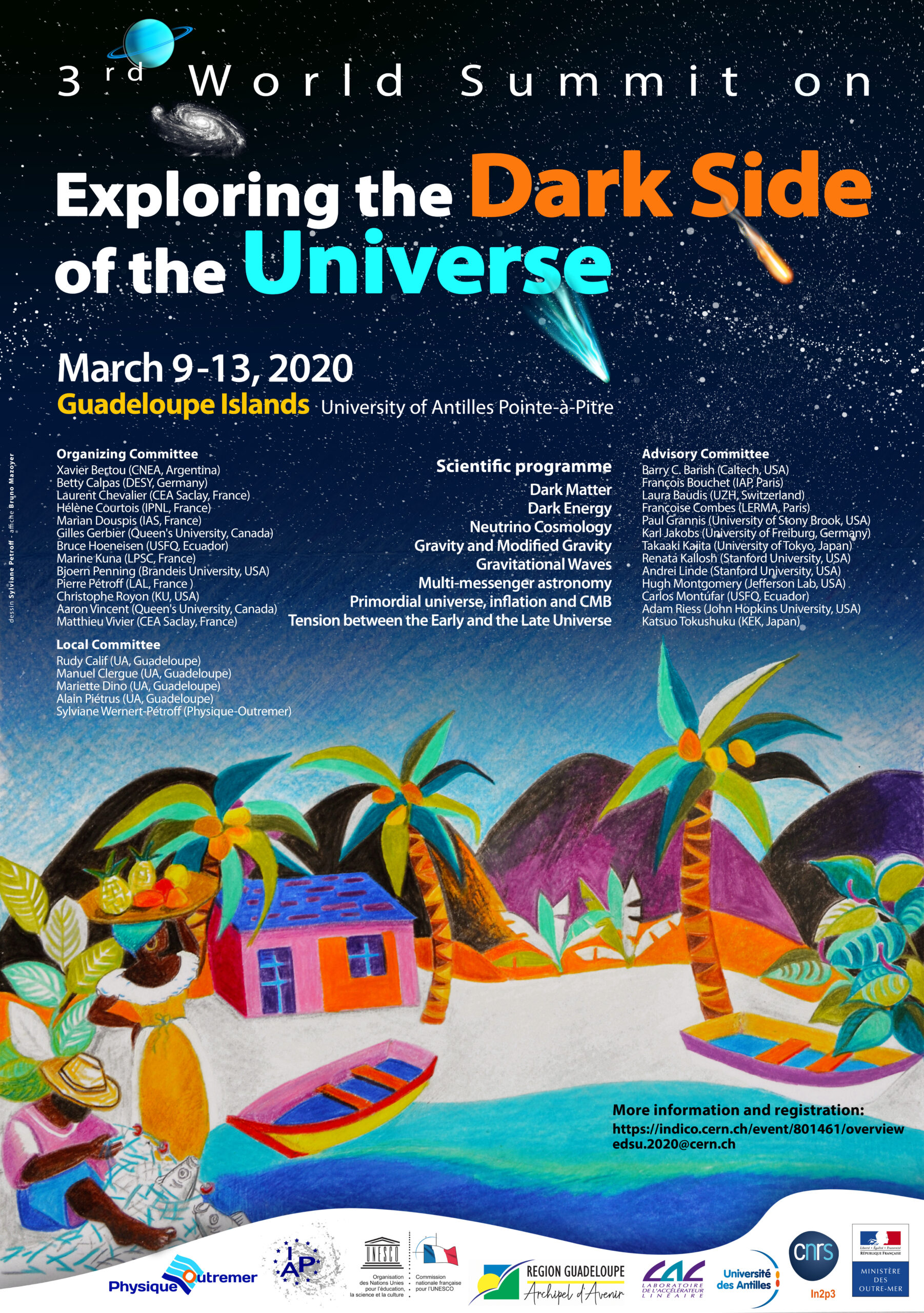
The 3rd World Summit meeting on Exploring the Dark Side of the Universe will take place from 9 – 13 March 2020 in Guadeloupe Islands. The main goal is to discuss progress and future directions related to outstanding issues, both in Cosmology and in Particle Physics. The successes and shortcomings of the Standard Cosmological model as well as the Standard Particle Physics model will be reviewed through the last astrophysical observations and accelerator experiment results.
— CANCELLED/POSTPONED, please check the website of the event for further information —
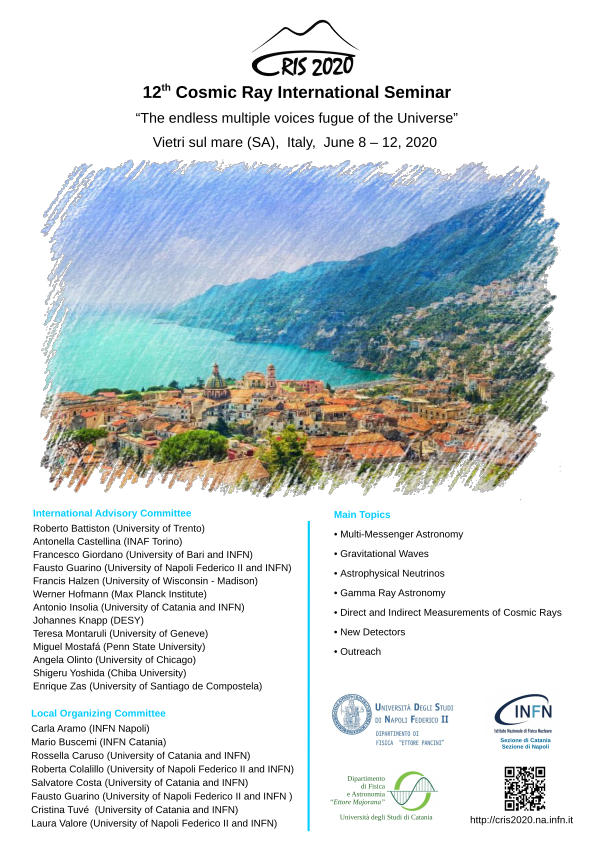
The 12th Cosmic Ray International Seminar (CRIS 2020) “The endless multiple voices fugue of the Universe” will be held in Vietri sul Mare (Amalfi Coast – Italy), 8th – 12th June 2020. The meeting will focus fundamental topics in astroparticle physics with specific emphasis on the new-born multimessenger astronomy studies. The meeting is being organized by the Catania and Napoli Divisions of the National Institute of Nuclear Physics (INFN), by the Department of Physics “E. Pancini” of the University of Napoli Federico II and by the Department of Physics and Astronomy “E. Majorana” of the University of Catania.
CRIS 2020, following the experience of previous editions, aims to present overviews of existing data and reports from the present and future experiments. Talks will cover both theoretical/phenomenological and experimental/observational aspects, in order to give an exhaustive overview of this complex field. The discussion about the present status and future plans requires to involve theorists and experimentalists working on various messengers. Thus, the progress in astroparticle physics achieved through space and ground-based detectors is expected to play a major role in the scientific program of CRIS 2020.
The 20th JINR-ISU Baikal Summer School on Physics of Elementary Particles and Astrophysics, will take place from July 14 to 21, 2020, in the picturesque village Bol’shie Koty (Big Cats) on the shore of Lake Baikal. Master and PhD students as well as early-career postdocs are invited to attend the School. The School offers:
a week of lectures given by invited experts in experimental and theoretical HEP and astroparticle physics,
plenty of time for questions and informal discussions with lecturers,
intensive study sessions in small groups,
an opportunity to present a talk or poster of own work,
friendly atmosphere, new contacts and friends,
and finally the stunning views of the lake Baikal and Siberian Taiga.


 On 16 October REINFORCE (Research Infrastructures FOR citizens in Europe) organizes a webinar for potential citizen scientists, Gravitational Wave Astronomy researchers and academics, members of the physics and astronomy community and educators. The webinar aims to give an overview of the first of REINFORCE Large Scale Citizen Science demonstrators which are the key vehicles that the project will utilise in order to bring frontier science and society together, showcasing the issue that the citizens will be asked to help in solving, how this activity will be performed relying on Zooniverse resources and technologies, and how the sonification of data will allow to widen the spectrum of people potentially involved.
 The 9th edition of the Very Large Volume Neutrino Telescope Workshop (VLVνT-2021) will be held from 20th to 23th April 2021, in Valencia, Spain. The workshop provides an ideal forum to discuss the latest developments in neutrino astronomy together with progress on the technological and instrumentation aspects of current and future large scale detectors in water and ice. It brings together the main collaborations working on neutrino telescopes (ANTARES, IceCube, KM3NeT, GVD) and is sponsored by the Global Neutrino Network (GNN).



 The 20th JINR-ISU Baikal Summer School on Physics of Elementary Particles and Astrophysics, will take place from July 14 to 21, 2020, in the picturesque village Bol’shie Koty (Big Cats) on the shore of Lake Baikal. Master and PhD students as well as early-career postdocs are invited to attend the School. The School offers: