Interview about the Gravitational Wave GW190521, detected by Virgo and LIGO, with Giovanni Losurdo
On 2 September the Virgo and LIGO collaborations published their discovery of the most massive Black Hole ever measured with Gravitational Waves. This is another huge milestone in the field of Gravitational Wave observations. The scientists observed the merging of two Black Holes of 66 and 85 solar masses, which generated a final Black Hole of around 142 solar masses. The particularity of this measurement and its impact on our understanding and knowledge of Black Holes will be explained to us by Giovanni Losurdo, spokesperson of the Virgo collaboration.
First of all congratulations to this new finding! Can you explain, why this observation is so unique?
This graphic shows the masses of black holes detected through electromagnetic observations (purple), black holes measured by gravitational-wave observations (blue), neutron stars measured with electromagnetic observations (yellow), and neutron stars detected through gravitational waves (orange). GW190521 is highlighted in the middle of the graphic as the merger of two black holes that produced a remnant that is the most massive black hole observed yet in gravitational waves. (Credit: LIGO-Virgo/ Northwestern U. / F. Elavsky & A. Geller )
Thank you! So far we knew two black hole families: the stellar black holes, with masses up to a few tens of solar masses (MS) and supermassive black holes (millions to billions MS). For the first time we have observed a so-called Intermediate Mass Black Hole in the range 100-1000 MS. This observation might be helpful to understand the origin of supermassive black holes and thus contribute to unveil one of the mysteries of our cosmos. And (what a happy coincidence!) while doing this interview we get the news about the Nobel Prize in Physics awarded to Reinhard Genzel and Andrea Ghez for the discovery of Sagittarius A, the supermassive black hole at the center of the Milky Way, together with Roger Penrose for his theoretical contributions.
Not only the highest ever measured remnant Black Hole is special in this system but also the mass of one of the primary Black Holes. Can you tell us more about this?
Indeed, there was a black hole in the binary system which should not exist…And this is the second reason why this event is so special, which also makes it puzzling. A mass of 85 MS falls in the so-called pair instability gap, a very important phenomenon in determining the fate of massive stars. The core of such stars may become very hot, so hot that photons become energetic enough to produce electron-position pairs. They thus disappear and, consequently, the radiation pressure, which competes with gravity maintaining the core stable, is progressively weaker and the star collapses. In this kind of collapse, according to the stellar evolution theory, there is no way to form a black hole as big as 85 MS. So how did it form? In one of the papers published on GW190521we have studied possible formation mechanisms, but each of them requires conditions which are not very likely. In any case astrophysicists have to scratch their heads!
What are the astrophysical implications from this discovery?
A still image from a numerical simulation of two black holes that inspiral and merge, emitting gravitational waves. The black holes have large and nearly equal masses, with one only 3% more massive than the other. The simulated gravitational wave signal is consistent with the GW190521 observation made by the LIGO and Virgo. (Credit: N. Fischer, H. Pfeiffer, A. Buonanno (Max Planck Institute for Gravitational Physics), Simulating eXtreme Spacetimes (SXS) Collaboration)
The LIGO and Virgo observations are unveiling the properties of binary system of stellar mass black holes. However, it is still an open question how binary black holes form and evolve; if they directly come from the evolution of an isolated binary systems of massive stars or if they are formed in dense environment, such as star clusters due to dynamical interactions. The properties of GW190521 signal lay the foundation for understanding its origin. The most plausible scenarios of formation of the two massive blackholes giving birth to the intermediate mass black hole are via multiple stellar coalescences, or via hierarchical mergers of lower-mass black holes in star clusters or in active galactic nuclei. The dynamical scenario is also supported by the mild evidence for precession found in the gravitational-wave signal.
Does this have any new implication on what we know on Dark Matter and Dark Energy?
Investigating the cosmos through gravitational waves may shed light on the 95% of the universe which we do not know yet.
For instance, the collapse of large overdensities in the early Universe might have directly formed so-called primordial black holes. Such black holes did not originate from stars, they did exist well before the stars. They are extremely interesting objects since their existence, if proved, could account for a fraction of the dark matter. In principle, it is possible that the binary components of GW190521 have a primordial origin, though this scenario is disfavored by the large spin of the primary black hole.
Moreover, detecting compact binary coalescences up to cosmological distances through gravitational waves provide an absolute distance scale measurement. The relation among gravitational wave distances and redshift carry the signature of the dark energy. Gravitational-wave detectors of 3rd generation, such as Einstein Telescope, will observe a larger redshift range ideal to investigate the nature of the dark energy and modifications of gravity on cosmological scales.
Do you expect to see more Black Hole mergers with these high masses?
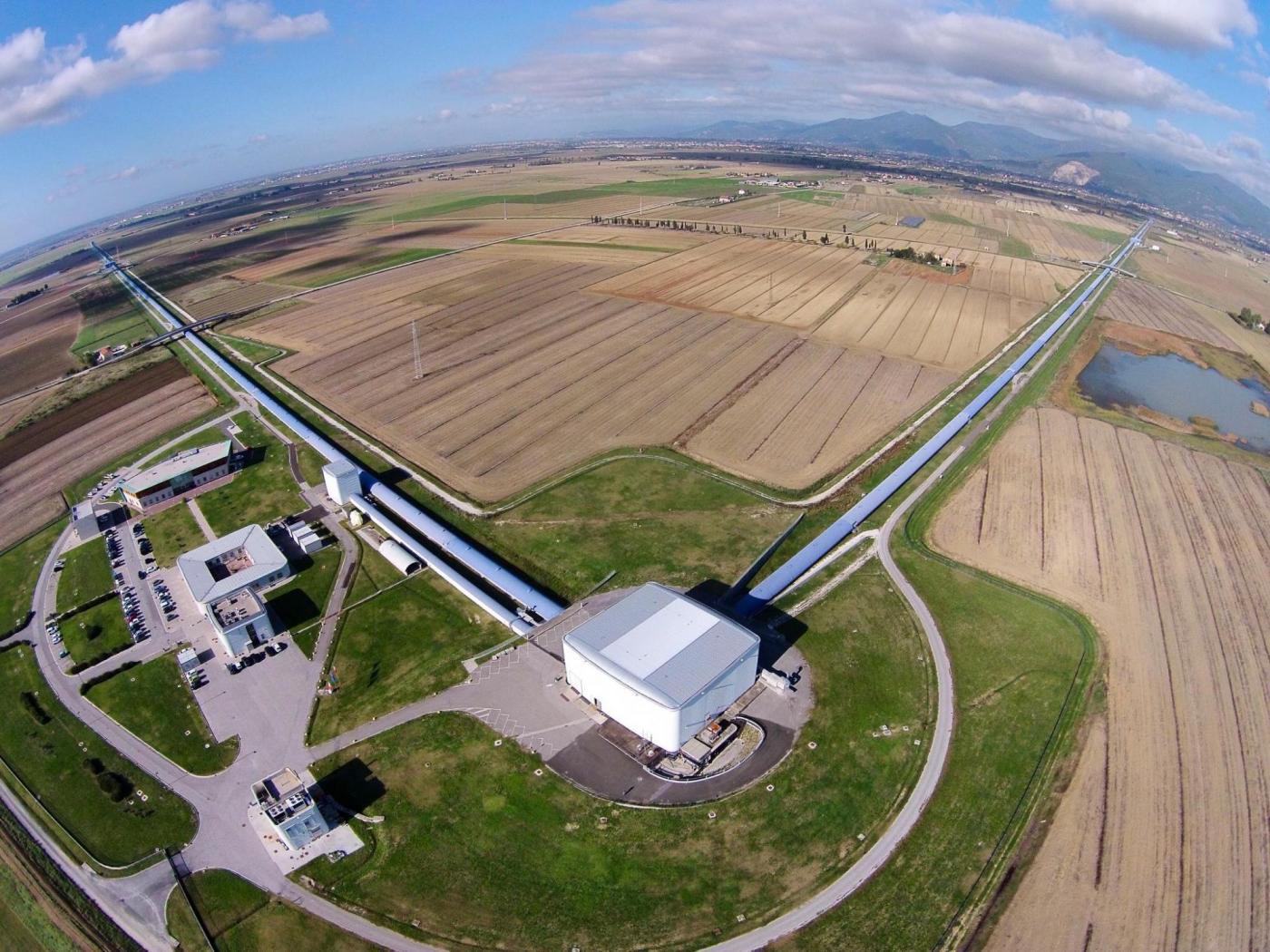
Aerial view of the Virgo experiment. (Credits:Virgo Collaboration/EGO)
Virgo and LIGO are now being upgraded in order to increase the volume of universe they can explore and thus the event rate. In fact, we alternate observing runs to periods when we work on enhancing the sensitivity of the detectors. Moreover, the KAGRA detector will join the network in the next observing run starting in 2022. As the world wide gravitational wave network becomes more sensitive the event rate increases. And so we expect that, in the next run, we might observe more events of this kind together with new, unexpected ones.
Events with high mass occur at lower frequencies – where LIGO and Virgo are less sensitive – do you expect to be still able to measure even higher masses?
In principle as we improve the sensitivities of the detector we might be able to see events with mass even larger than GW190521. However, the real breakthrough towards higher masses will happen with Einstein Telescope, the third generation European project aiming to widen the Virgo bandwidth down to 1 Hz. Furthermore, ET will explore all the observable Universe increasing the probability to detect the merger of intermediate massive black-holes.
Giovanni Losurdo is a Research Director of the National Institute of Nuclear Physics (INFN). He has worked on the Virgo experiment since its early years, in the 1990s. From 2009 to 2017 he has been the Project Leader of Advanced Virgo, the interferometer enhancement program that made it possible, in August 2017, to contribute to the observation of the gravitational waves emitted in the merger of two neutron stars, an epochal discovery that initiated a totally new way of observing the cosmos: multi-messenger astronomy. He is now serving as Spokesperson of the Virgo Collaboration.
He won the Galilei Prize for Science and the Tartufari Prize for Physics and Chemistry from the Accademia dei Lincei. He was awarded by President Mattarella with the honor of “Commendatore dell’Ordine al Merito della Repubblica Italiana”. Since 2019 he is a member of the Accademia Nazionale dei Lincei.
Interview on the status of the Einstein Telescope with Michele Punturo and Frank Linde
During the last year the Einstein Telescope (ET) Collaboration was busy with the preparation for an ESFRI Roadmap proposal which was just submitted. This is an enormously important step for the realization of the project and was a lot of work for the whole collaboration. In this interview we will discuss with Michele Punturo and Frank Linde the status of the ET project and the way to its completion.
ET shall be one of the so-called 3rd generation Gravitational Wave (GW) observatories. Can you explain what characterizes this new generation and why we need such observatories?
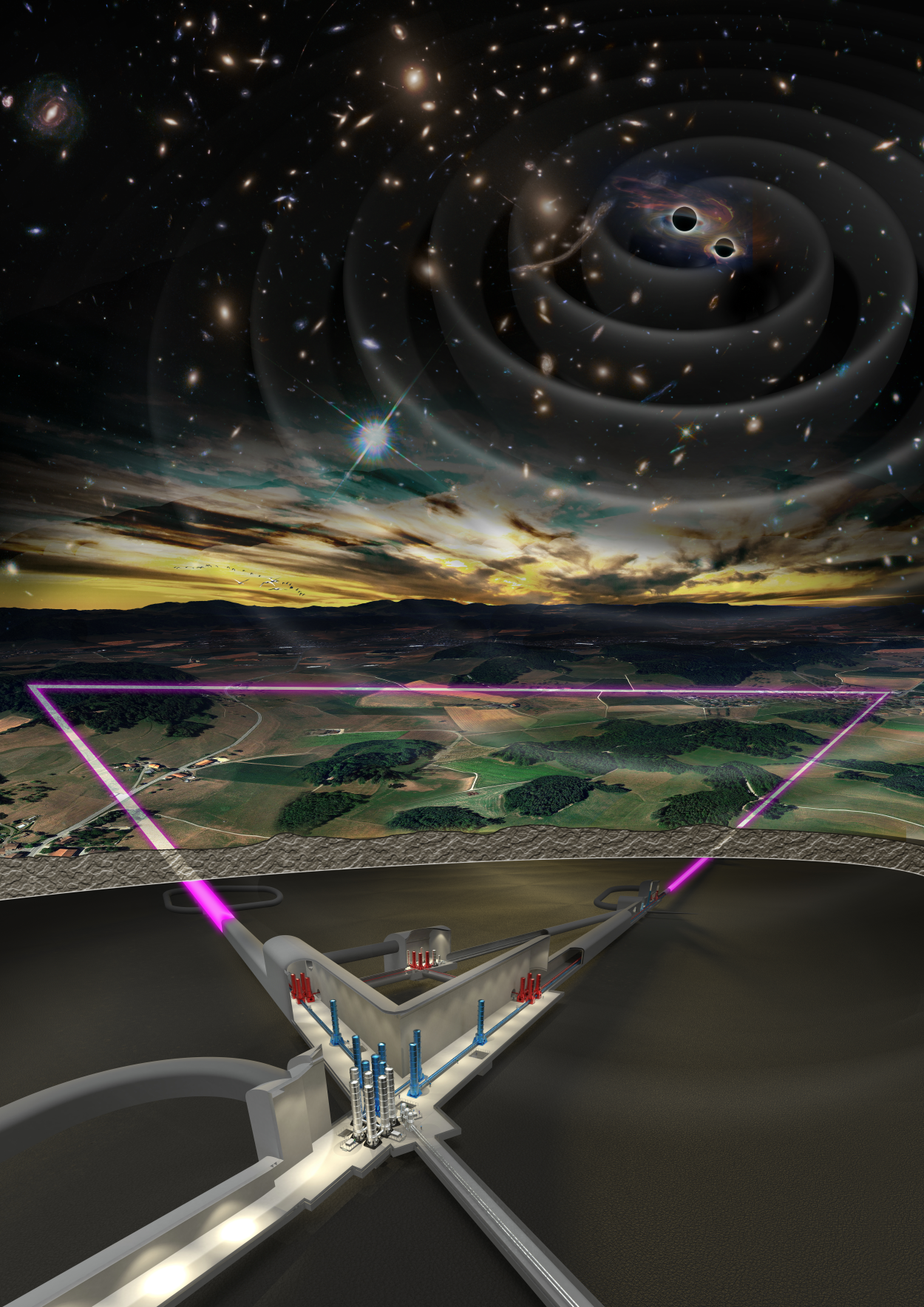
Artist view of the Einstein Telescope. (Credits: ET Steering Committee)
Punturo: ET will be a 3rd generation GW observatory because it will have a sensitivity to GW signals by one order of magnitude better than the advanced detectors (Advanced Virgo and Advanced LIGO). This will reflect directly on the detection range, a factor 10 larger, and on the detection rate, approximately increased by a factor 1000. Furthermore, ET is designed to enhance the sensitivity at low frequency, below 10Hz, focusing the attention in this way on massive sources, like the intermediate-mass black holes, recently discovered by Advanced Virgo and Advanced LIGO in a coalescence of two stellar mass black holes (GW190521). ET will be able access the entire population of stellar mass and intermediate mass black holes over the entire history of the Universe. All these characteristics will allow ET to explore for the first time the Universe through gravitational waves along its cosmic history up to the cosmological dark ages, shedding light on open questions of fundamental physics and cosmology. It will probe the physics near black-hole horizons (from tests of general relativity to quantum gravity), help understanding the nature of dark matter (such as primordial BHs, axion clouds, dark matter accreting on compact objects), and the nature of dark energy and possible modifications of general relativity at cosmological scales. ET will observe the neutron-star inspiral phase and the onset of tidal effects with high signal-to-noise ratio providing an unprecedented insight into the interior structure of neutron stars and probing fundamental properties of matter in a completely unexplored regime. In order to accomplish all these targets, ET needs to develop and implement new technologies in optics and optoelectronics (mirrors, quantum optics, fiber lasers, …), new materials (test masses in Silicon, optical coatings, …), cryogenic plants, precision mechanics for seismic filtering, system control and noise suppression. ET will need a new large infrastructure, located underground in a quiet location, in order to mitigate the seismic and environmental noise.
How would you describe the current status of the ET project?
Punturo: We realised the ET conceptual design few years ago and the development of the ET enabling technologies is already started thanks to a series of European and international grants. The 9th of September 2020 we submitted the ET proposal for the 2021 update of the ESFRI roadmap, the major European roadmap describing the most important research infrastructures for the next decades. Currently we are working on the detailed design of the infrastructure and of the detectors, developing the technologies and characterising the two sites identified for ET, one in Sardinia, Italy and one in the Meuse-Rhine Euroregion across the border between Belgium, Germany and The Netherlands. Furthermore, we are strengthening the ET collaboration, attracting groups and competences from the GW scientific community and from the neighbouring communities. In fact, multi-disciplinarity is one of the major characteristics of the GW research.
What is already ongoing on preparations, R&D-projects and site characterization projects for both possible sites in Sardinia and the Meuse-Rhine Euroregion?
Simulation of gravitational waves caused by merging neutron stars. (Credits: R. Hurt/Caltech-JPL)
Punturo: As mentioned before, ET needs to develop new technologies to achieve its target sensitivity. In particular, we need lasers operating at different wavelength with respect to the one adopted in advanced detectors; since we will operate at cryogenic temperature, we need to produce low noise cryogenic plants, new materials (e.g. Silicon at low temperature instead of Silica) for the ET mirrors, new optical coatings, new ways to suspend that complex optical systems, filtering the seismic vibrational noise. Different groups in Europe are developing these technologies, but the ET collaboration is totally open to new contributions.
For the site characterisation we defined a common platform of requirements and parameters to be tested in the two sites, in order to have a complete and efficient comparison.
We are investigating the Sardinia as possible site for ET since the very beginning of the ET Design Study, about 10 years ago. Seismic, magnetic and acoustic sensors have been installed at different depth in the Sos Enattos mine, close to Lula (Nuoro); this mine is unused but still maintained in safe and accessible conditions. Sardinia is one of the most quiet regions in Europe in terms of natural seismic noise, geological stability and anthropic noise. This has been confirmed by very recent studies, that qualify the site of Sos Enattos as one of the quietest 40 sites in the world (in the frequency range of interest for ET). With the support of the Sardinia local government (3,5M€) an underground laboratory (SarGrav) is under realisation, to be used as seed for ET and for research activities in a quiet environment. The entire area around the Sos Enattos site is under investigation and a set of boreholes is under preparation to fully characterise the vertices of the ET site. These investigations are possible through a grant of about 18M€ provided by the Italian government, addressed to the candidature of the site. French and Polish groups are collaborating to the site characterisation. A consortium of national research institution, open and evolving toward a more international configuration is collaborating to the candidature of the site. We also evaluated the social and economic impact of the ET infrastructure in Sardinia, thanks to a very detailed study realised by the University of Sassari (ET-0008A-20, https://apps.et-gw.eu/tds/ql/?c=15437)
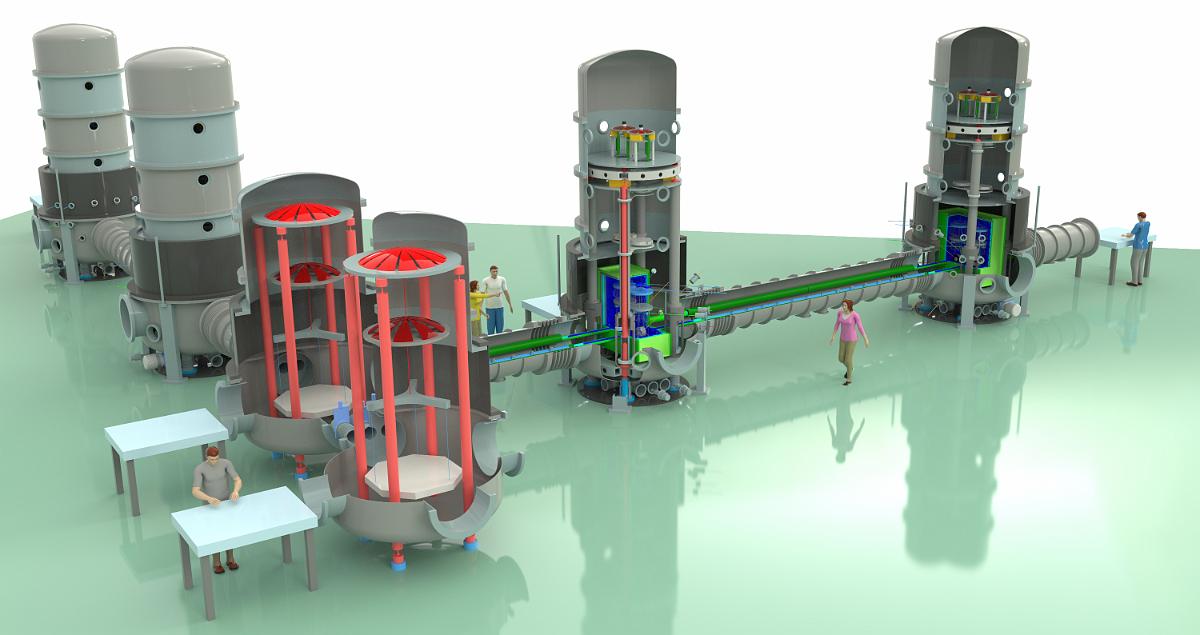
Model of the ETpathfinder. (Credits: Marco Kraan, Nikhef)
Linde: Regarding the Meuse-Rhine Euroregion, seismic studies (passive & active campaigns as well as drill holes) have started in 2017. Since May 2019 a seismic sensor at 250 meters depth is continuously monitoring the ambient seismic noise. Results to date are near the desired Einstein Telescope specifications. Supported by a large (15 M€) Interreg-EMR grant (‘E-TEST’) more detailed seismic studies will be performed by a multi-disciplinary consortium including various expert geology and seismic research groups and institutes in Belgium, Germany and The Netherlands. By 2023 E-TEST should culminate in an optimal siting of ET in the Meuse-Rhine Euroregion.
Regarding instrumentation, the focus is on ‘ETpathfinder’, a 14,5 M€ Interreg Vlaanderen-Nederland project, to realize a laser-interferometer R&D laboratory in Maastricht – home of an entirely new gravitational-waves research group – aimed at a key innovation: the use of cryogenic (10-20 K) silicon mirrors as test masses. The ETpathfinder consortium welcomes any institute/individual to join.
Apart from these research-oriented activities, an ‘Impact assessment of the Einstein Telescope’ was published by Technopolis (see https://www.einsteintelescope.nl/wp-content/uploads/2019/02/impact-assessment-of-the-einstein-telescope.pdf) and Implenia published a report on the civil engineering and cost aspects of the Einstein Telescope. Substantial activity is invested in setting up collaborations with (regional) industrial partners. Not only because we need (high-tech) industry to realize major parts of the Einstein Telescope but also because eventual national pledges towards building the Einstein Telescope will require a balanced return of investments.
You just submitted an ESFRI Roadmap proposal. How does this connect with the future of the whole project?
Punturo: The ET proposal, submitted to the ESFRI roadmap, is supported by a team of five countries (Belgium, Poland, Spain, The Netherlands) leaded by Italy and the ET consortium is signed by about 40 institutions (national funding agencies, National Research Institutions and Universities) belonging also to France, Germany, Hungary, Norway, Switzerland and United Kingdom. This is a great starting point for the preparation and the realisation of the ET infrastructure. We need a real pan-European alliance to realise ET and probably it will evolve toward a so-called Global Research Infrastructure, as soon as the future of the companion project, Cosmic Explorer, in the USA, will be more defined.
Where do you consider the biggest challenges on the way to the realisation of ET?
The Einstein Telescope is designed as a triangle of long tunnels, spanning 10 km each. It will be located 200-300m underground. (Credits: Thijs Balder, Nikhef)
There are different kind of challenges:
Technological challenges: We need to gain a factor of ten of sensitivity with respect to the advanced detectors, that are already the most sensitive “sensor” ever realised, capable to measure vibrations having an amplitude spectral density at 100Hz of about 10-20m·Hz-1/2. Going down in sensitivity and in frequency, the list of disturbances that can spoil the sensitivity, becomes longer and longer and it will be a real challenge to realise, implement and tune all the new apparatuses needed in ET.
Challenges in the realisation of the civil infrastructures: We want to realise an infrastructure comparable in size and in difficulty with very few large research infrastructures in the World, but the ET requirements in terms of environmental noise are terribly stringent.
To support and realise ET we need a collaboration definitely larger than the current LIGO-Virgo-KAGRA community. The realisation and the governance of a so large community and a so large observatory are a large social and management challenge.
Finally, the most challenging target is to attract enough financial resources, stimulate political interest and international cohesion to fund ET. European governments and institutions have demonstrated, in the recent history, many difficulties to have a common strategy; The challenge of such a high funding, unprecedented in the APP community, can be achieved through strong intergovernamental cooperation and solid design strategy to avoid competition but foster synergy between partners.
Part of your process is a Letter of Intent which should constitute the basis of the ET collaboration. Is this part already finalized or is there still the possibility to sign?
Punturo: The ET Letter of Intent is the first embryo of the ET consortium agreement and like all the embryos it is fully open to the evolution and to the grown. 41 institutions signed the ET Letter of Intent, many more will sign the ET consortium agreement.
Michele Punturo is Director of Research at the Istituto Nazionale di Fisica Nucleare (Perugia, Italy). He worked at CERN, in CP violation experiments (NA31, NA48) and then in Virgo, having the role of Detector Coordinator and of Computing coordinator. He proposed and coordinated the ET design study project in 2008-2011, coordinated the ELiTES project 2012-2017, addressed to exchange technologies and researcher between the ET and the Japanese KAGRA experiment and now is co-chairing the ET steering committee.
Frank Linde
Frank Linde is professor of experimental high-energy physics –elementary particle physics– at the University of Amsterdam. He has worked on experiments at large particle accelerators such as LEP (Z and W bosons) and LHC (discovery of the Higgs boson) at CERN (Geneva). From 2004 to 2014 he was director of the National Institute for Subatomic Physics (Nikhef). In 2015-2016 he was APPEC (Astroparticle Physics European Consortium) chair. Since 2017 he leads gravitational-waves research at Nikhef. Linde has extensive hands-on and managerial experience with large scientific research infrastructures.
Interview on Gravitational Waves Expression of Interest with Tetyana Galatyuk and Paolo Pani
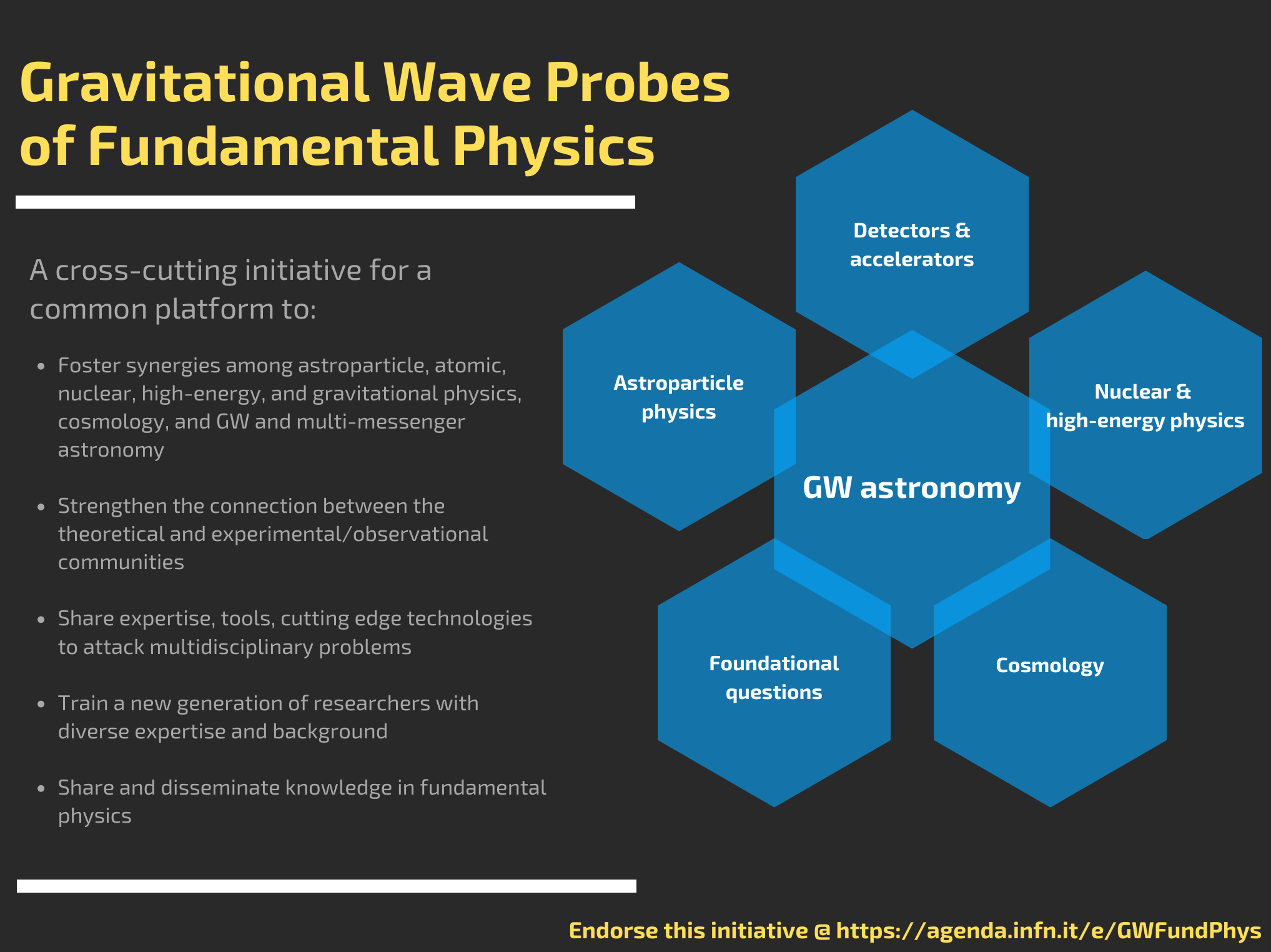
In response to the JENAS call the Gravitational Wave Community prepared an open Expression of Interest on “Gravitational Wave Probes of Fundamental Physics”. Already two weeks after the announcement, the list of endorses counted over 500 people. Tetyana Galatyuk and Paolo Pani, who played a key role in the writing and submission, will explain in this interview the aims and ideas of the EoI.
Can you briefly describe how the idea of this EoI came about?
Tetyana: The landmark detection of gravitational waves has opened a new era in physics, giving access to hitherto unexplored systems. In parallel to their countless astrophysical applications, these discoveries open new avenues to explore fundamental physics in many different aspects at both theoretical and experimental level. In this context, the two of us have been independently involved in efforts to diversify our own communities and strengthen the synergies between different subfields, for example by serving as coordinators of sub-working groups of the COST Action GWverse and as speaker of the Topic Cosmic Matter in the Laboratory (CML) within Helmholtz Program „Materie und Universum“. Recently, we have been approached by Prof. Gianfranco Bertone, who proposed to prepare a JENAS Eol as a way to extend and formalize the synergies among different communities.
Paolo: The idea and the themes of the Eol emerged very naturally, since for some time there has been an underlying feeling that different communities working at the interface between astroparticle, nuclear, and gravitational physics would have enormously benefit from a stronger interaction between each other. In particular, current and future gravitational-wave detections can provide an answer to long-standing open problems in fundamental physics, such as the behaviour of matter under extreme conditions, the nature and phenomenology of dark matter and dark energy, the existence of new fundamental fields, the nature of black-holes, and the quest for possible extensions of Einstein’s General Relativity. Some of these problems are cross-cutting among different disciplines and require new developments at theoretical and experimental level.
Tetyana: Given the current state of affairs, our communities are often exploring related problems from different perspectives and could benefit from a common platform to share ideas and expertise. Our goal is to create such a platform, boost current synergies, and explore new ones.
Paolo: We aim to establish a “meta-community” that can embrace different, more specific fields, while at the same time offering a platform for young researchers to be trained and a multidisciplinary visiting program across Europe.
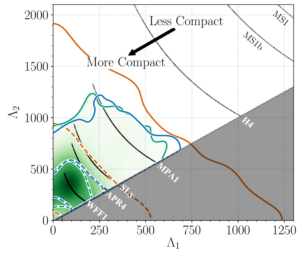
Marginalized posterior for the tidal deformabilities Λ_i of the two binary components of GW170817, the first binary neutron-star event detected by LIGO/Virgo. Smaller Λ_i correspond to more compact stars and, in turn, to a softer equation of state. From Abbott+ Phys. Rev. Lett. 121, 161101 (2018)
How do you envision achieving these aims?
Paolo: First of all, we need to build/consolidate a cross-cutting community. In order to achieve that, we envise organizing a kick-off meeting to get the many scientists who expressed interest in this Eol involved and to discuss with them the best actions. A core part of our proposal will be the training of a new generation of researchers working at the interface between different fields, and this will require another core aspect: the organization of visiting programs that have been proved to be highly beneficial to create synergies among different fields.
Tetyana: A concrete outcome will be the creation and maintenance of a webpage, including a repository to share codes, tools and other data that can be useful in interdisciplinary studies, e.g., state-of-the-art equations of state, observational/experimental data, numerical codes, analytic methods and waveforms models, data-analysis tools, cosmological models.
JENAS was a joint effort from the Particle, Astroparticle and Nuclear Physics Community, how are these three communities represented in your EoI?
Paolo: We precisely aim to foster synergies among different communities, in particular astroparticle, atomic, nuclear, high-energy, and gravitational physics, cosmology, and GW and multi-messenger astronomy.
Tetyana: Given these are the main topics of the APPEC, ECFA and NuPECC, it was just natural to respond to the JENAS call with this Eol.
Group picture from JENAS-2019.
How could APPEC, ECFA and NuPECC support you?
Paolo: We believe the three consortia can play a key role in our joint initiative. Their support is clearly essential to reach out to all interested colleagues in Europe, and to establish, in a series of kick-off meetings, a forum where particle, astroparticle, and nuclear physicists can meet and identify synergies among different communities, as well as innovative strategies to explore fundamental physics with gravitational waves.
Tetyana: In the medium and long term, we hope that APPEC, ECFA and NuPPEC can help us secure financial support for meetings and for the consolidation of the community, both at EU level and with national agencies.
Are you already planning concrete steps for the near future?
Tetyana: We believe that the most urgent action is to secure funds to kick-start the activities listed in the Eol. We plan in particular to apply for a new COST action.
Paolo: COST actions are particularly interesting as a funding instrument for us, as they have proven to be extremely successful in supporting large scientific networks in Europe, as demonstrated by the related actions GWverse and PHAROS. We will soon reach out to the community to coordinate the submission of the COST Action proposal.
Tetyana Galatyuk is Group Leader “QCD Matter Research” in the department HADES at GSI and Full Professor of Experimental hadron- and nuclear physics at the Institute of Nuclear Physics in Darmstadt. In 2012 she was awarded a Helmholtz Young Investigator Group “Exploring Quark Matter with VIrtual Photons” to study the phase structures of strongly interacting matter under extreme conditions of temperature and density using high-energy heavy-ion collisions and became a Junior Professor at TU Darmstadt. She is the recipient of the 2013 Röntgen-Preis, of the 2009 Preis der Freunde und Förderer der Universität Frankfurt. Her main research topics are the dilepton and hadron spectroscopy with hadron and heavy-ion beams, phenomenology of electromagnetic radiation from heavy-ion collisions, detector instrumentation.
Paolo Pani
Paolo Pani is Associate Professor of Theoretical Physics at Sapienza, University of Rome (Italy). He is Junior Fellow at Sapienza’s School for Advanced Studies and member of the Scientific Committee of the Amaldi Research Center for gravitational physics. He coordinates the ERC project DarkGRA (“Unveiling the dark universe with gravitational waves”) and other national projects. He received the SIGRAV Prize and the Outstanding Referee award from the American Physics Society. He is co-author of the book “Superradiance” and of over 100 scientific publications on black-hole physics and gravitational-wave phenomenology, and their connections to fundamental physics.
Interview with Federico Sanchez about the recent results of T2K collaboration
Recently the T2K experiment published in Nature their results on the constraint of leptonic CP violation. Although there is no one-to-one link between the matter antimatter asymmetry and the value of delta from the T2K measurement, these results are a major step forward in the study of difference between matter and antimatter. Federico Sanchez explains how T2K measures CP violation and what they can conclude.
Congratulations for your results and their publication. Can you explain why a different behaviour of matter and antimatter is so important?
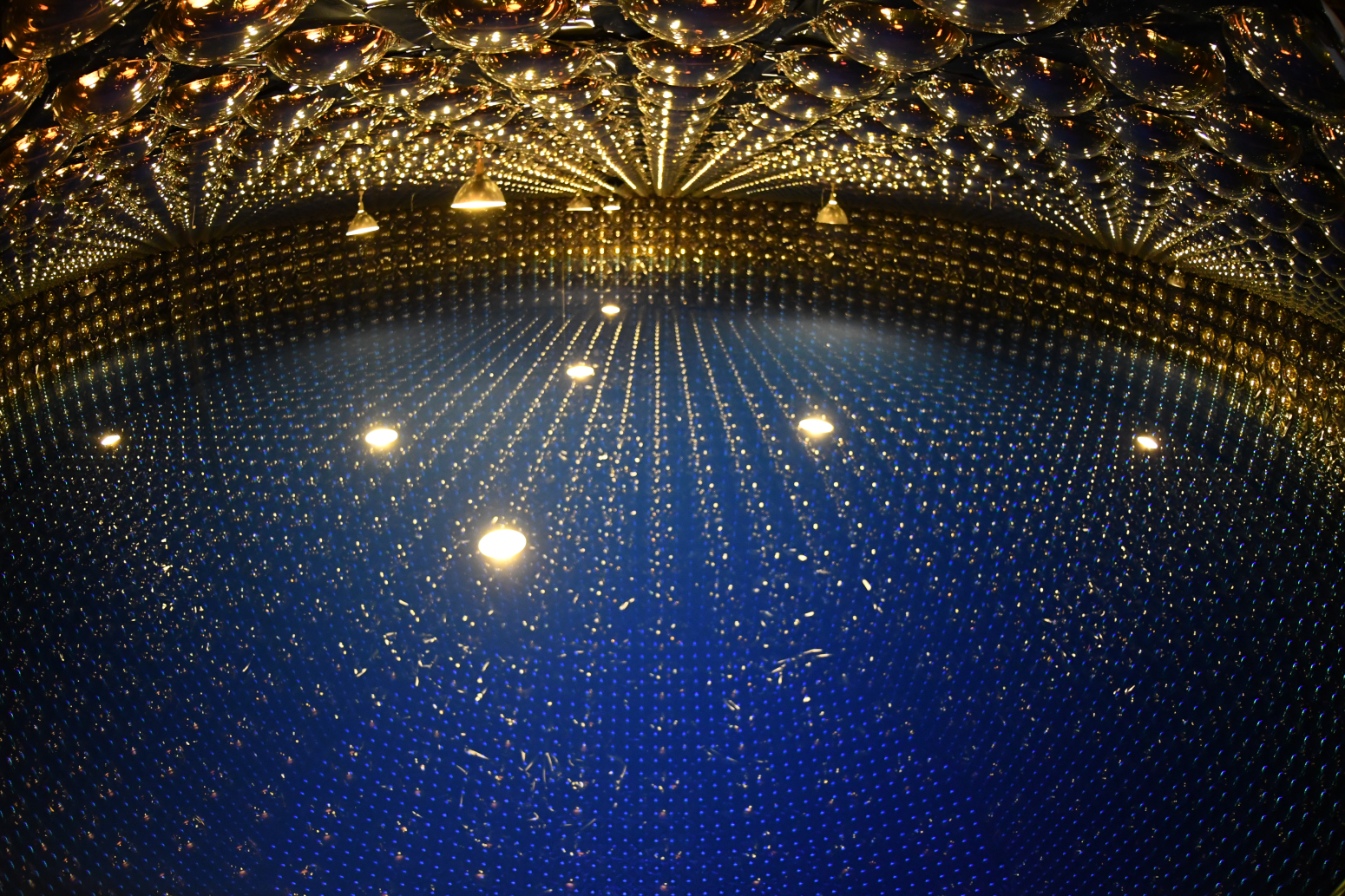
Inside the Super-K detector. Credit: Kamioka Observatory, Institute for Cosmic Ray Research, University of Tokyo
The different behavior of particle and antiparticles, or matter and antimatter, is by its own a breakthrough result. The different behavior of particle and antiparticles is a possibility contemplated in the Standard Model describing the fundamental particles. CP violation with leptons is described by a fundamental parameter, the phase angle δCP which is the parameter measured at the T2K experiment. There is no specific prediction of the value of this angle in our theoretical models. Its determination is important to advance in the understanding of the standard model. CP violation is related to flavor-changing mechanisms in the standard model, its measurement may help to understand more deeply the flavor dynamics. Flavor is what physicists identify with the differences between the three lepton families (electron, muon, and tau) or the three quark families. CP violation is a known phenomenon in processes involving quarks since the 1960’s. It has taken the particle physics community almost 60 years to start seen similar behavior in leptons. I believe this is the most relevant implication of the T2K result.
Besides the relevance to particle physics, CP violation might have implications in the understanding of our matter-dominated Universe. The existence of CP violation mechanism is one of the three conditions proposed by Andrei Sakharov to explain the baryon(or matter) asymmetry of the Universe. Baryon number violation and interactions out of thermal equilibrium are the other two. CP violation is then a necessary condition although not a sufficient one. The CP violation amount and its origin are relevant to model this asymmetry. I would like to stress that we are still far from understanding this mechanism, the baryon number violation has not been proved experimentally so far, and it is not obvious that the CP violation in neutrinos and quarks are the mechanisms required to explain the baryon asymmetry in the universe. Although some theoretical models connect both phenomena, there is a long way to go. Hopefully, the new results can help in this challenging enterprise.
Can you explain the measurement principles of T2K?
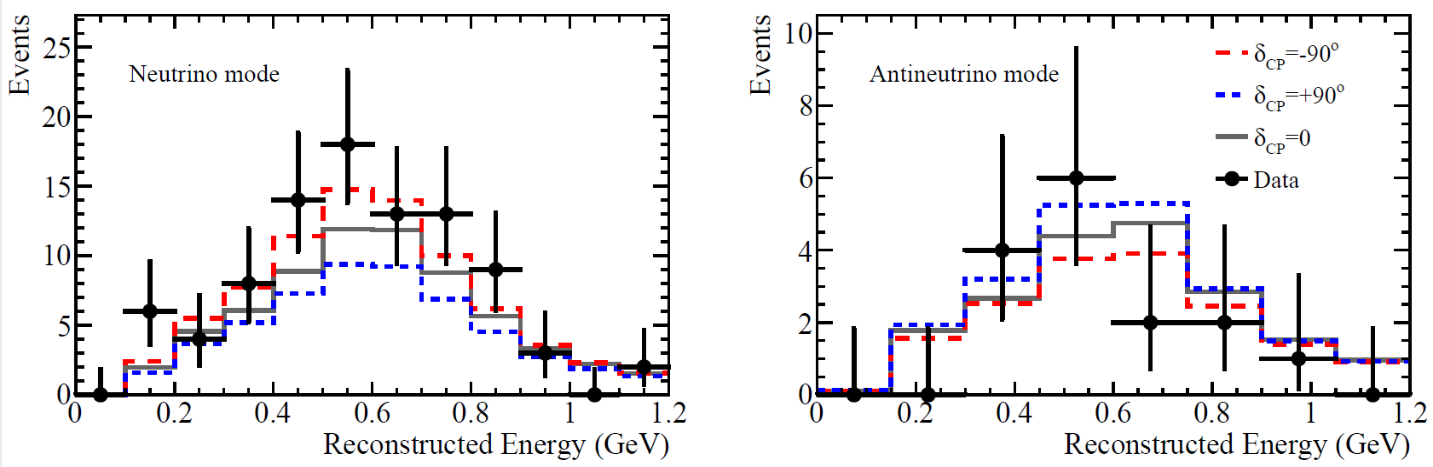
The observed electron neutrino (left) and electron antineutrino (right) candidate events with predictions for maximal neutrino enhancement (red, long dash) and maximum antineutrino enhancement (blue, short dash). Credit: the T2K experiment
T2K collaboration studies the so-called neutrino oscillations. The neutrino oscillation is a quantum mechanical interference caused by the fact that every neutrino of the type electron, muon, or tau is a combination of three neutrino masses. The neutrino type electron, muon, or tau is determined by the associated heavy lepton (electron, muon, or tau) in the interaction. The neutrino has three paths to travel from the production to the interaction points. Each one associated with one neutrino mass. The neutrinos travel as a superposition of these three states, each one with a different mass and speed, producing the interference patterns. Experimentally, this quantum mechanical interference is measured by looking at the appearance of types of neutrinos at the interaction point different from the ones that were produced. Particularly in T2K, we look for the transformation of muon neutrinos into electron neutrinos. The CP phase induces differences in the oscillation for the neutrinos and its antiparticles, the antineutrinos. In T2K, we have measured the oscillation parameters for neutrinos and antineutrinos and from the difference, we can infer the value of the CP violation phase. The T2K experiment can produce both neutrinos and antineutrinos simply by focusing or defocusing positively charged pions and negatively charged pions. The positive pions produce neutrinos during its disintegration and negative pions produce antineutrinos.
Your experiment is sensitive to the δCP Phase, which parameter space can you exclude and what does this mean?
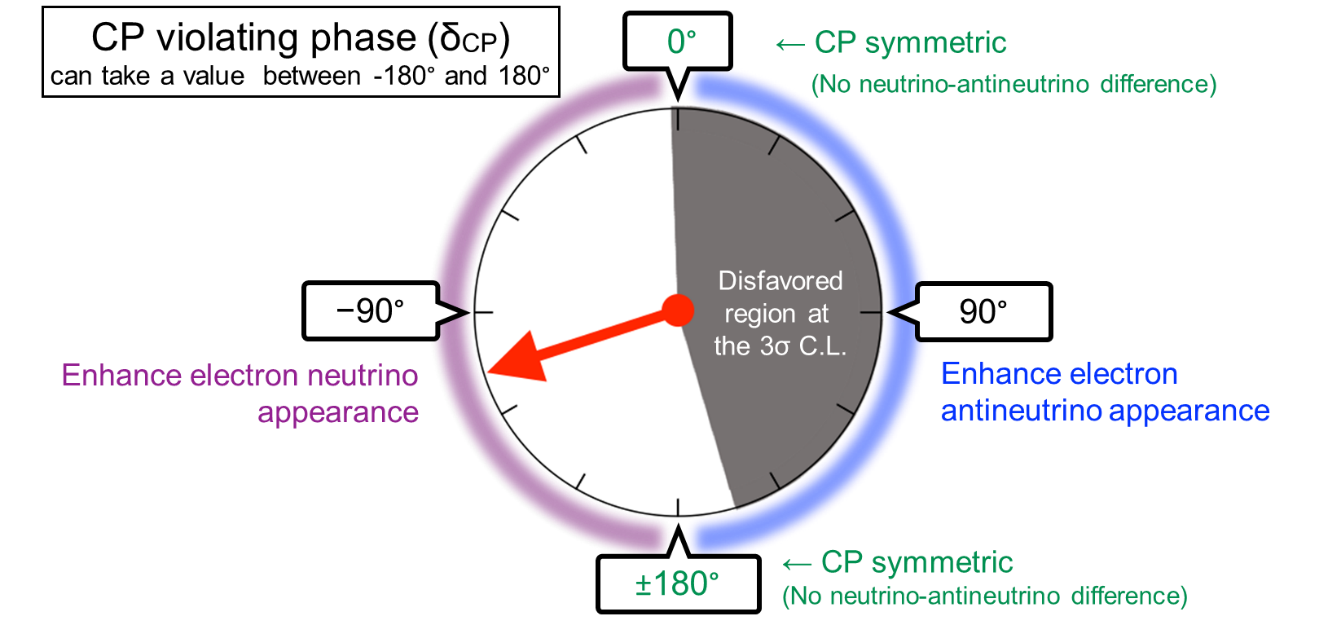
The arrow indicates the value most compatible with the data. The gray region is disfavored at 99.7% (3σ) confidence level. Nearly half of the possible values are excluded. Credit: the T2K experiment
The result from T2K excludes half of the possible values of δCP, particularly the positive values of the phase angle are excluded with a confidence level of 99.7%. If we take possible values of δCP from -180 degrees to 180 degrees we excluded values from -1.7 degrees to 164.6 degrees. This is the first time we have measured experimentally this fundamental parameter in the Standard Model.The other important read of the T2K results is that the most probable value of the δCP is close to -90 degrees implying the maximal violation of the CP symmetry in neutrinos. The fact that it can be maximal open possible ways to understand the mechanism that differentiates neutrino mass states from flavor states.
What are the consequences of the constrain of T2K on the δCP in the neutrino sector on the matter-anti-matter asymmetry?
When confirmed, the result might have several implications. First of all, it is a new source of CP violation beyond the traditional one in the quark sector. This additional source plus the special properties of neutrinos might explain through a relevant theory the origin of the matter-dominated Universe through theoretical models. Another relevant implication is related to the value of δCP. If the result is confirmed to be maximal as suggested by T2K, this might have theoretical implications since it might be a reflection of hidden symmetries in a model.
What are your ideas to further improve the measurements?
In particle physics, 99.7% is not sufficient to claim a discovery. We need values of the confidence level of 99.9999%. To reach this precision we need more data, the 115 events collected by T2K are not enough. To achieve larger statistics there are few venues we are taking. The first one implies running longer time, the second to increase the flux of neutrinos, and third to increase the mass of the far detector. The first step is just time and money, we will keep running a few years more hopefully doubling or tripling the number of neutrinos we detect. The second step can be done by increasing the total number of protons we can accumulate in the accelerator per unit of time. Protons produce the pions that subsequently produce neutrinos by decay. There is already an approved project that will almost double the number of protons during the next years. The third one requires new detectors. Recently, the upgrade of the T2K far detector, SuperKamiokande, was approved by the Japanese authorities. The new project, HyperKamiokande, will increase the detector mass and the number of detected neutrinos per unit of proton in the accelerator by almost a factor of ten. With this increase, we can accumulate ten times more neutrinos for the same number of protons than we do today. Unfortunately, this will not be sufficient. In parallel, we need to understand some of the uncertainties of the experiment. These uncertainties are related to better control of the neutrino flux predictions and the modeling of neutrinos interacting with nuclei. Both are at the moment the most relevant non-statistical uncertainties in the measurement and they will become dominant when we increase the number of detected neutrinos. To address these issues, we need supporting experiments to help to understand the production of pions by proton interactions and to improve the understanding of neutrino interactions. We also need to develop more precise theoretical models describing the interaction of neutrinos with nuclei so we can interpret these experiments correctly, and in parallel, we need to prove experimentally they are correct.
We would like to add a short comment by Silvia Pascoli in which she discusses the results of the T2K experiment in a theoretical context. We asked her about the connection between T2K results and the baryon asymmetry of the Universe.
A simple assumption, justified by cosmological inflation, is that the Universe at the very beginning contained the same amounts of matter and antimatter. In the 60’ A. Sakharov identified the conditions which are required for some process in the Early Universe to generate a small asymmetry between matter and antimatter: the violation of the C and CP symmetry, lepton (or baryon) number violation, which is testable in neutrino less double beta decay, and the out of equilibrium condition.
Leptogenesis, using leptonic CP violation, is among the favourite explanations of the baryon asymmetry as it takes place in models which have been proposed to explain the observed neutrino masses. Under certain conditions, specifically in see-saw type I neutrino mass models, it has been shown that the leptonic CP violating delta phase searched for in long baseline neutrino oscillation experiments can be the source of the observed matter-antimatter asymmetry. This is a highly non-trivial statement as in many other models the baryon asymmetry that can be generated is too small.
Observing leptonic CP violation and the violation of lepton number would provide circumstantial evidence (although not a proof) towards leptogenesis as the origin of the matter-antimatter asymmetry of the Universe.
We asked her to further comment on the connection to neutrinoless double beta decay.
First of all, as I discussed above, lepton number violation is one of the three key criteria for leptogenesis to explain the baryon asymmetry of the Universe. Neutrino less double beta decay is the most sensitive test we have of this global symmetry of the Standard Model. Moreover, the results of T2K and NOvA and other neutrino oscillation experiments on the ordering of neutrino masses play a key role in the predictions for the lifetime of the decay process. So, mass ordering information is very important to plan the future program in this field and to interpret the results from future experiments.
Federico Sanchez graduated at the Univ. of Sevilla and got his PhD at the Universitat Autònoma de Barcelona working at an experiment at CERN. He worked as a researcher at DESY and at the Max Planck Institute fur Kernphysik in Heidelberg where he acted as co-physics coordinator of the HERA-B experiment. He has worked at several particle physics experiments such as ALEPH and LHCB at CERN or HERA-B at DESY.
In 2002, he joined the K2K experiment in Japan and since then he was working on neutrino physics as the leader of the group at IFAE. He participates in the T2K experiment in Japan from almost the very beginning. In 2016, he was one of the researchers awarded the Breakthrough prize on fundamental physics which was given to the K2K and T2K collaborations for the experimental establishment of neutrino oscillations. Between 2007 and 2011, he was a member of the Nemo and SuperNemo collaborations and contributed to the preliminary ideas of the NEXT experiment.
In August 2018, he moved as a professor at the Université of Genève to take the responsibility of the group dedicated to neutrino physics at the T2K and HK experiments. In April 2019, Federico was elected International Co-Spokesperson of the T2K collaboration.
Interview with Marco Cirelli, Caterina Doglioni, Gaia Lanfranchi and Florian Reindl
In October 2019 the first Joint ECFA – NuPECC – APPEC Seminar (JENAS) took place in Orsay, close to Paris, where a call has been issued for novel Expressions-of-Interest. Following this call a group of Dark Matter scientists have drafted an open EoI to gather the broader dark matter community. Among others (see full list here), Marco Cirelli, Caterina Doglioni, Gaia Lanfranchi and Florian Reindl initiated the “Initiative for Dark Matter in Europe and beyond: Towards facilitating communication and result sharing in the Dark Matter community (iDMEu)”. In this interview they present their ideas and aims for this EoI.
You are working in various countries and experiments. Where and how did you come up with the idea for the EoI?
Florian: The idea of this EoI was born at the JENAS meeting, which took place in October last year in Orsay.
Marco: Yes, although I knew many of my colleagues from previous meetings, the JENAS workshop was just the concrete occasion that allowed us to meet in person and the idea of an EoI to emerge.
Florian: The main spirit of this meeting was the wish to strengthen the bonds between the different communities, working on fundamentally different approaches to detect DM (e.g. direct, indirect and collider searches, but also fixed-target, beam-dump and dedicated axion/ALP experiments). We are all working on dark matter in different countries, for different experiments and in different communities, but agreed that even in the dark matter community a common “platform” to share ideas, data etc. is missing. This was the starting point which evolved in the EoI.
Caterina: We see this EoI as a platform to bring together different existing efforts. An effort is, for instance, the LHC Dark Matter Forum / Dark Matter Working Group, where LHC theorists and experimentalists are connecting LHC results on WIMPs to direct and indirect detection experiments. In the LHC community there is also a growing wish to expand the DM menu beyond WIMPs, both conceiving new models and finding new experimental signatures.
Gaia: When we first discussed in Orsay, I immediately understood the importance of the initiative and I supported it. For me it represents the natural evolution of my activity within the Physics Beyond Colliders (PBC) study group. The PBC was launched by the CERN management in 2017 with the aim to investigate the potential of the CERN accelerator complex and scientific infrastructure for projects aiming to answer the same fundamental questions as those at colliders but requiring a different type of beams and experiments. To investigate the nature of DM beyond the WIMP paradigm was already part of this effort. The PBC study group gathered together colleagues from collider, beam dump, fixed target, axion/ALP experiments, and astroparticle to explore synergies and complementarities of different theoretical and experimental approaches.
What are your aims and how you want to realize them?
This image shows the galaxy cluster Abell 1689, with the mass distribution of the dark matter in the gravitational lens overlaid (in purple).(Credit: NASA, ESA, E. Jullo (JPL/LAM), P. Natarajan (Yale) and J-P. Kneib (LAM))
Florian: Nowadays, dark matter is commonly accepted as one of the fundamental open questions of physics. Therefore, we see the community quickly growing and approaching the dark matter problem from very different angles experimentally like theoretically. The result is a very active and lively, but also very diverse community. The idea of the EoI is to bring all those people together to take full advantage of all we “know” about dark matter already and to also make full use of cross-links for future work. The EoI is intended to show that there is a broad interest of the actors in the field to actually do this. It is also meant as a basis to jointly work on a concrete implementation.
Gaia: The origin and nature of DM is one of the deepest mysteries in particle physics today and we need to attack this problem from different fronts. Theory wise, we need to understand which other relevant hypotheses about the DM nature should be considered beyond the standard WIMP paradigm and how these hypotheses fit into a general theory framework. Two prominent examples are, for example, axions with masses in the micro-eV range or light DM with thermal origin in the MeV-GeV range. Experiment wise, we need to identify synergies and complementarities across different experimental approaches in order to enlarge the exploration as much as possible while optimising resources. In order to pursue these goals, first of all we need to develop a “common language”, which means to identify a common theory framework: theoretical and experimental physicists need to talk together in order to identify motivated benchmark models which could be tested experimentally. A first step in this direction was done within the Physics Beyond Colliders activity and allowed us to put together results from a wide variety of experimental efforts. This framework could be further improved with the help of the particle and astroparticle theory community and more experimental results can be included.
Caterina: Because we know so little about the nature of dark matter, I am keen to try to keep pursuing it from all directions. My own direction is the LHC, and I want to collaborate as much as possible with all others, experimentalists and theorists, who can point the community in the most promising directions towards a discovery. Since one of my passions at work is data acquisition and computing, I am also keen to connect the work of this initiative to that of the HEP Software Foundation, which facilitates collaboration and sharing of software; and to the ESCAPE project, a multi-collaboration effort across particle and astroparticle physics that aims to establish a collaborative cluster of scientific infrastructures that work together on Open Science implementations of our research tools.
Marco: I am a theorist, so I don’t work in any specific experimental collaboration. But as a theorist, I pay a lot of attention to results achieved by my experimental colleagues. The search for Dark Matter in recent years has literally boomed and expanded in a myriad of interesting directions, with many new theory ideas (at different mass scales, embedded in different frameworks or simply standalone) and many new experimental setups (ranging from tabletop to full-fledged international collaborations). This ‘explosion’ is of course positive and incredibly exciting, but also needs to be somewhat framed and patterned in order to be more efficient. To realize this, we want to rely on the work already produced in the different communities. We want to act at the ‘human relations’ level (conferences, meetings, cross-talks) and at the technical level (online repositories, sharing of results, common services).
You already have more than 200 endorsers. Do they represent the Particle-, Astroparticle- and Nuclear Physics Community? What are their main interests?
Florian: We have endorsers from all communities and also from experiment and theory. I would like to note that this EoI was born in Europe, but the EoI is not restricted to Europe and we find supporters all over the world. What brings us together is to solve the puzzle of dark matter.
Content of the Universe (credit: HAP / A. Chantelauze)
Gaia: Within the signatories I recognize the names of friends, colleagues, and distinguished physicists belonging to the three communities with a very broad spectrum of interests, from collider physics, to DM direct and indirect detection experiments, flavour physics, gravitational waves, and particle and astroparticle theory. I do believe that this excellent and broad mixture of different expertise will strengthen the EoI program.
Marco: In addition to the different scientific backgrounds, I can also recognize among the endorsers people at different career stages, ranging from some of the senior policy makers of the field to young postdocs and some PhD students. This, I think, is very healthy and shows the grassroots nature of the initiative.
Gaia: We are living a period of confusion in particle physics, old paradigms seem to be inadequate to answer fundamental questions, and new ones are still to be defined. Nevertheless I have seen in the last few years an increasing interest from people belonging to different communities to cross boundaries, talk together, exchange ideas and results, towards the common goal of understanding fundamental laws of Nature. Nature is the same for everyone. This EoI is the expression of an already existing and widespread movement in this direction and that is why it is getting a large support.
Marco: The diverse scientific interests and backgrounds are in a sense natural, since the Dark Matter problem is by its very nature transdisciplinary. In another sense, this also shows that many sub-communities are perhaps restructuring themselves in this period and that many colleagues that were working on other subfields are now reorienting their research towards Dark Matter.
Caterina: One of the key points of this initiative in my opinion is to be inclusive of everyone’s interests and voices. Many of these voices are already being heard in working groups where “expert work” is ongoing, such as DMWG and PBC, and we will rely on their work to set the direction and topics of the future steps. Even if we distributed the EoI link quite broadly, we may not have reached out to everyone who is interested. Therefore, this is by no means a “closed” list – we will turn this list of endorsers into a mailing list with an archive that will be on the indico page so that others can sign up along the way.
What do you expect that APPEC-ECFA-NuPECC organisations can do?
Marco: The organizations have already done a lot, just by making the interesting and highly non-trivial JENAS meeting possible, that spurted our initiative. By keeping the channels of communication open in between the communities (e.g. organizing other similar meetings, or providing logistical support to initiatives like ours) I think that these organizations can have a very positive role.
Gaia: We need help on several fronts. First of all, we need guidance from APPEC-ECFA-NuPPEC, to better understand what can be realistically done and with which priority. Second, the help of these organisations will also be invaluable to have this effort officially recognized in the Institutes of all active participants in order to:
have a framework in which this proposal can be developed;
get support for related activities (space/logistic/funding for meetings/conferences/workshops, setup of publicly accessible repositories where to store results/algorithms/webpages, etc);
improve the communication in two directions:
across the three scientific communities in order to spread information about events, discussions, and results,
towards the general public in order to convey a common message and present our research progress as a common story, as truly is.
Do you think your work can influence the EPPSU, and if not this one, maybe the next?
Group picture from JENAS-2019.
Caterina: Some of us proposing this EoI had also already worked together on the Briefing Book towards the update of the European Strategy of Particle Physics, where we wrote an “Outlook on synergies” in the Dark Matter chapter reflecting the wish for closer collaborations between the astroparticle, particle and nuclear physics in terms of common search targets and common tools (e.g. experimental technologies, shared software repositories…).
Gaia: there is already a widespread and large movement in the direction of work across theory-experiment and across different communities. This movement cannot be stopped at this stage, but certainly can be better organized. I hope that the ESPPU delegates will not miss the opportunity to further boost the already lively and rich particle, astroparticle and nuclear physics communities.
Caterina: There were already favourable steps in this direction in the 2013 strategy, which have led to the creation of initiatives such as EuCAPT, an astrophysics theory centre within CERN, whose help we’ve been relying on for the hosting of this EoI and further initiatives.
Marco: I don’t think that initiatives like ours are meant to ‘influence’ processes like the EPPSU. In some sense, we are just aiming to deal with the day-to-day business of Dark Matter research in a more streamlined way (creating links, putting in place technical tools, facilitating communication…) rather than devising the broad lines of the strategy. We are bold enough to think that Dark Matter is already a clear crucial priority of our field, and we would like to make the process of searching for it more efficient.
Caterina: This EoI is meant to encourage communication within a platform that will help DM researchers in Europe and worldwide, and will have useful practical outcomes such as common repositories and shared outreach material.
What will be the next steps?
Florian: We have some next steps sketched at our indico page. I think the most important one is a kick-off meeting organized at CERN (with an available remote connection), which will be followed up by meetings at upcoming conferences and workshops.
Marco:The kick-off meeting will be an occasion to further understand the work that is already being done in many working groups aimed at structuring DM searches in different subfields. Then we will discuss the next steps with the community of endorsers.
Florian: We also plan to establish a common repository to share experimental data (or use existing repositories) coming along with frameworks for their theoretical interpretation. Also, we will from the beginning work together on public outreach, such as e.g. the international dark matter day.
Gaia: My personal opinion is that in a first stage we should rely on existing activities and facilitate communication among them. As far as I am concerned, I will further boost the work done within the Physics Beyond Colliders study group during the workshop FIPs 2020 organized at CERN in May 2020. At this meeting, we will discuss, among other topics, results and prospects for light DM and axion searches with a wide variety of experimental techniques and with the help of renowned theoretical and experimental experts in these fields. I know that a similar effort is being done within the DM@LHC workshop and I have been invited to their annual meeting in June 2020 at DESY to discuss possible synergies. We hope to be present at the APPEC, ECFA and NuPPEC town meetings and to establish an annual meeting of iDMEu.
Further reading:
Initiative for Dark Matter in Europe and beyond iDMEu
Marco Cirelli is a senior CNRS researcher at the Laboratory of Theoretical and High Energy Physics (LPTHE) of Sorbonne University, in Paris. He obtained his PhD from Scuola Normale Superiore of Pisa, Italy, in 2004 and subsequently worked at Yale University, Saclay and CERN. From a background as a particle theorist, he slowly drifted towards astroparticle theory and cosmology. His interests have been revolving around the issue of Dark Matter for the past 15 years. In particular he focuses on searches using charged cosmic rays (positrons, antiprotons, antinuclei), high-energy gamma rays and neutrinos. From 2012 to 2018 he has led the ERC project “NewDark” (New Directions in Dark Matter Phenomenology at the TeV scale).
Caterina Doglioni
Caterina Doglioni is a senior lecturer at Lund University (Sweden). She completed her PhD on QCD physics at the ATLAS experiment at the LHC in 2011 in Oxford. Her interest in physics beyond the Standard Model and Dark Matter was developed during her postdoctoral research position at the University of Geneva (2011-2015) and subsequently at Lund University (2015-now). She is the PI of the DARKJETS ERC Starting Grant, and she is supported by the Swedish Research Council. Throughout her career, she has been driven by finding out more about the constituents of matter as well as by the challenges related to the “big science” needed to study them. The Large Hadron Collider is the perfect scientific environment to combine the two: with her group and colleagues she works on the challenges that a data-rich research environment presents for discoveries of rare processes at ATLAS (more information about dark matter at ATLAS). She has been one of the Dark Matter Forum and Dark Matter Working Group organizers from 2014 to 2018, and ATLAS Astroparticle Forum convenor from 2016 to 2018. She is currently the chair of the Swedish Physics Society Board for Particle and Astroparticle Physics, a member of the coordination team of the HEP Software Foundation (HSF), as well as HSF trigger and reconstruction working group coordinator.
(Photo credits: Lena Björk Blixt)
Gaia Lanfranchi
Gaia Lanfranchi is a senior researcher at the Laboratori Nazionali di Frascati of the INFN.
After about 15 years of activity in flavor physics within the LHCb collaboration where she had several roles of coordination and responsibility, in 2014 she moved her scientific interest towards the study of feebly-interacting hidden sectors. She has been convener of the Beyond the Standard Model (BSM) working group of the Physics Beyond Colliders activity at CERN and member of the BSM @ Colliders working group of the Physics Preparatory Group which provided input to the current European Strategy for Particle Physics update. She is one of the proponents and project leader of the muon system of the SHiP experiment proposed at the Beam Dump Facility at CERN.
Florian Reindl
Florian Reindl is a researcher at the Technical University Vienna and the Institute for High Energy Physics (HEPHY) Vienna. He finished his PhD in 2016 in Munich (Max-Planck-Institute for Physics and Technical University) and worked at INFN Rome, before moving to Vienna. Since the beginning of his career he has been working in data analysis for the CRESST direct dark matter detection experiment serving as the CRESST analysis coordinator since several years. The main focus of his recent work was to explore very light dark matter particles. He is an initiator and the spokesperson of the COSINUS project which is currently under construction at the LNGS underground laboratory. COSINUS is based on CRESST low-temperature technology and aims to clarify the long-standing dark matter claim of the DAMA collaboration. The biggest event for Florian in 2020 will be to chair the identification of dark matter (IDM) conference in Vienna.
Interview with Razmik Mirzoyan and Stefan Wagner on their successful measurements of GRBs with MAGIC and H.E.S.S.
On 14 January 2019, Swift has reported the detection of a long GRB 190114C (GCN #23688). The MAGIC telescopes started observations of this GRB about 50 s after the Swift-BAT alert, reaching more than 20 sigma of significance in 2 hours. At the CTA Science Symposium on 6-9 May 2019, also H.E.S.S. announced the detection of GRB 180720B in its afterglow phase at the level of 5 sigma in about 2 hours of observations. Three papers on these relevant findings where later published in Nature. We would like to congratulate on this major breakthrough and interviewed the two spokespersons of the experiments, Razmik Mirzoyan and Stefan Wagner.
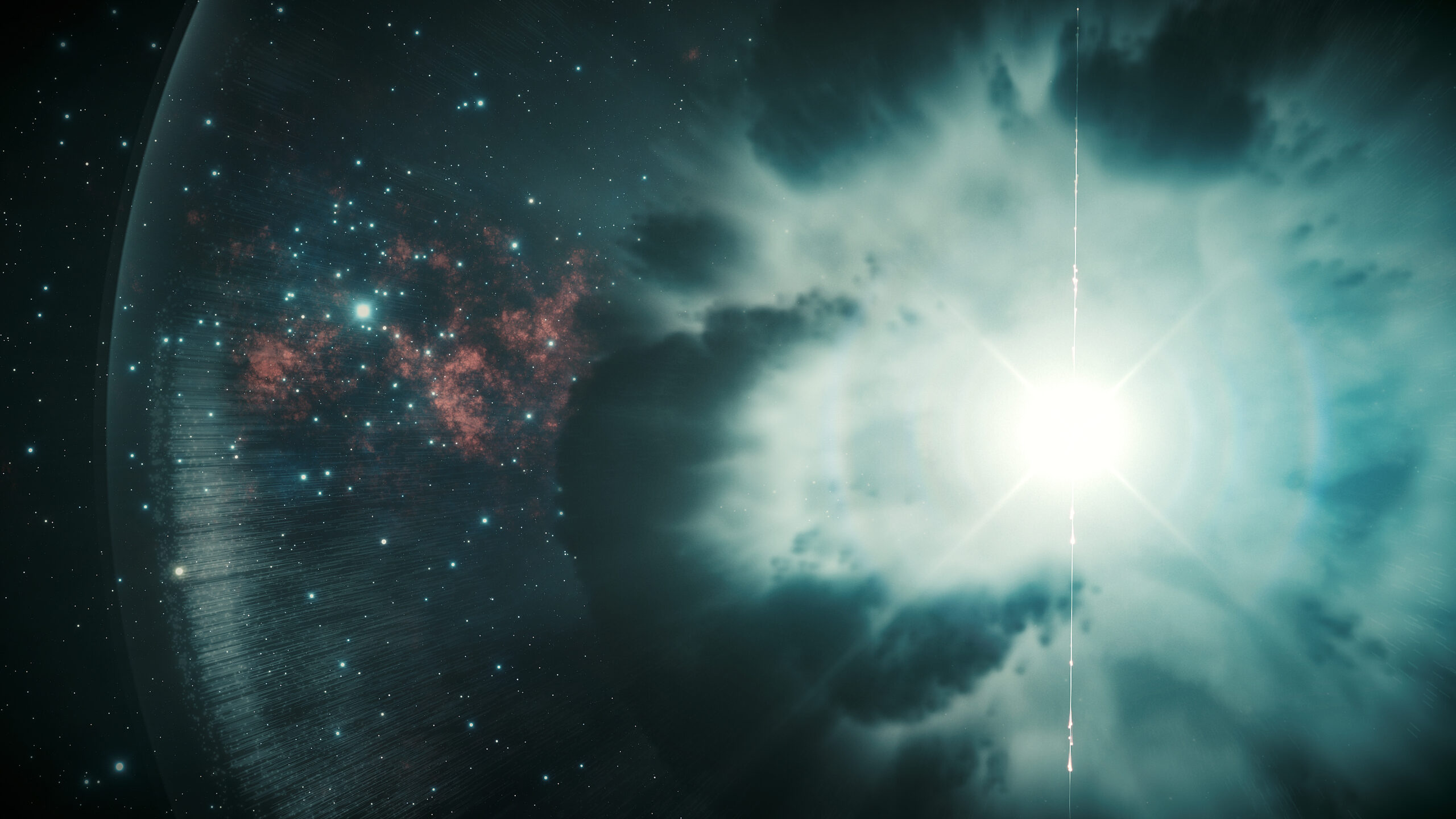
Artist view of a GRB. Credits: DESY, Science Communication Lab
MAGIC observed bright early emission from GRB 190114C in January 2019, H.E.S.S. the faint afterglow emission of GRB 180720B in July 2018. What do you think led to the breakthrough in these observations?
Mirzoyan:
MAGIC detection of the GRB 190114C has been published in ATel #12390 and the GCN Circular #23701 in the night of 14/15th January 2019. MAGIC detected the most intense ever gamma-ray signal from any celestial source since the invent of ground-based very high energy gamma-ray astronomy; in the first 30s the intensity of emission was 130 times that from Crab Nebula, the standard candle in VHE astronomy. This is a very happy occasion to celebrate the 30 years birthday of the ground-based gamma-ray astronomy.
In late 1990’s many technological novelties were suggested, developed and implemented in the design of MAGIC, it was planned as a real High-Tech telescope and our senior colleague Eckart Lorenz has a major contribution in these. The main goal was in the first time to measure Active Galactic Nuclei, GRB, pulsars and galactic sources in the not yet explored energy range below 200 GeV, down to few tens of GeV. For this purpose we optimised most parameters of the telescope. One of the main goals was to promptly react to GRB alerts from satellite missions. With a lot of technological efforts we were finally able to re-position the telescope to an arbitrary position in the sky within 25 s.
Although MAGIC was designed to observe GRBs, our multiple tries year-over-year remained unsuccessful. Despite that, we “polished” the GRB observation strategy of MAGIC over years and in the end we could operate these in a fully automatic observation mode; the incoming alert, after short evaluation by the software, triggers a sequence of actions for possibly fast observing the alerted position; no human interaction is involved in these. We were very well prepared for the next-best GRB alert arrival. And this is what has happened in the evening of January 14th 2019, when the telescopes fully automatically moved to the position alerted by the Swift satellite and started observations.
Initially the crew on the shift was astonished because despite the large zenith angle of ~60° and the presence of the partial Moon they could observe very fast increasing in intensity signal from the unknown position. Late in the evening of January 14th I got a call from the shift crew in La Palma and got informed about what was going on; the collected data for the first 20 minutes showed more than 20 sigma significance in the online analysis. I asked the crew to observe the GRB as long as it is possible during that night. The rest of the night I spent communicating with my colleagues scattered worldwide, checking again and again the authenticity of the signal. Few hours after the onset of the burst, in the hope that possibly large number of instruments could join observations of the GRB 190114C, I sent an ATel and a GCN circular. Very early on the following morning I flew to Tucson, AZ, for attending the inauguration of the Schwarzschild-Couder telescope. Big was my surprise when arriving at the conference location I was overwhelmed by curious questions and numerous congratulations from my colleagues, including also the leading colleagues from Veritas, H.E.S.S., and CTA.
Wagner:
We commenced our specific GRB program very early after the H.E.S.S. array started observations and have followed up several dozen triggers over the past 15 years. While many features of the GRB programme were continuously improved in order to enable a fast reaction to automatic triggers, the very first GRB ever to be detected with our telescopes last year was actually discovered in the deep afterglow phase, more than 10 hours after the initial event. At the time of the prompt burst, the source was below the horizon for the H.E.S.S. telescopes. The burst originated at a rather high redshift (by VHE standards) and hence suffers from significant photon-photon pair-absorption on the extragalactic background light. The discovery was possible thanks to the enormous light collection power of the 28m CT5 telescope of the H.E.S.S. array.
What can we learn about GRBs from these new measurements? Did they lead to a common picture concerning the modelling of gamma-ray bursts?
Wagner:
The most important message of the first detection is that GRBs clearly emit very high energy emission deep in the afterglow phase. At least in the specific case of GRB180720B the energy flux in the VHE band is comparable to the energy flux in the X-ray band even 10 hours after the burst – similar to the match between the X-ray band and the HE band probed with Fermi 100s after the burst when the flux was still 5000 times brighter.
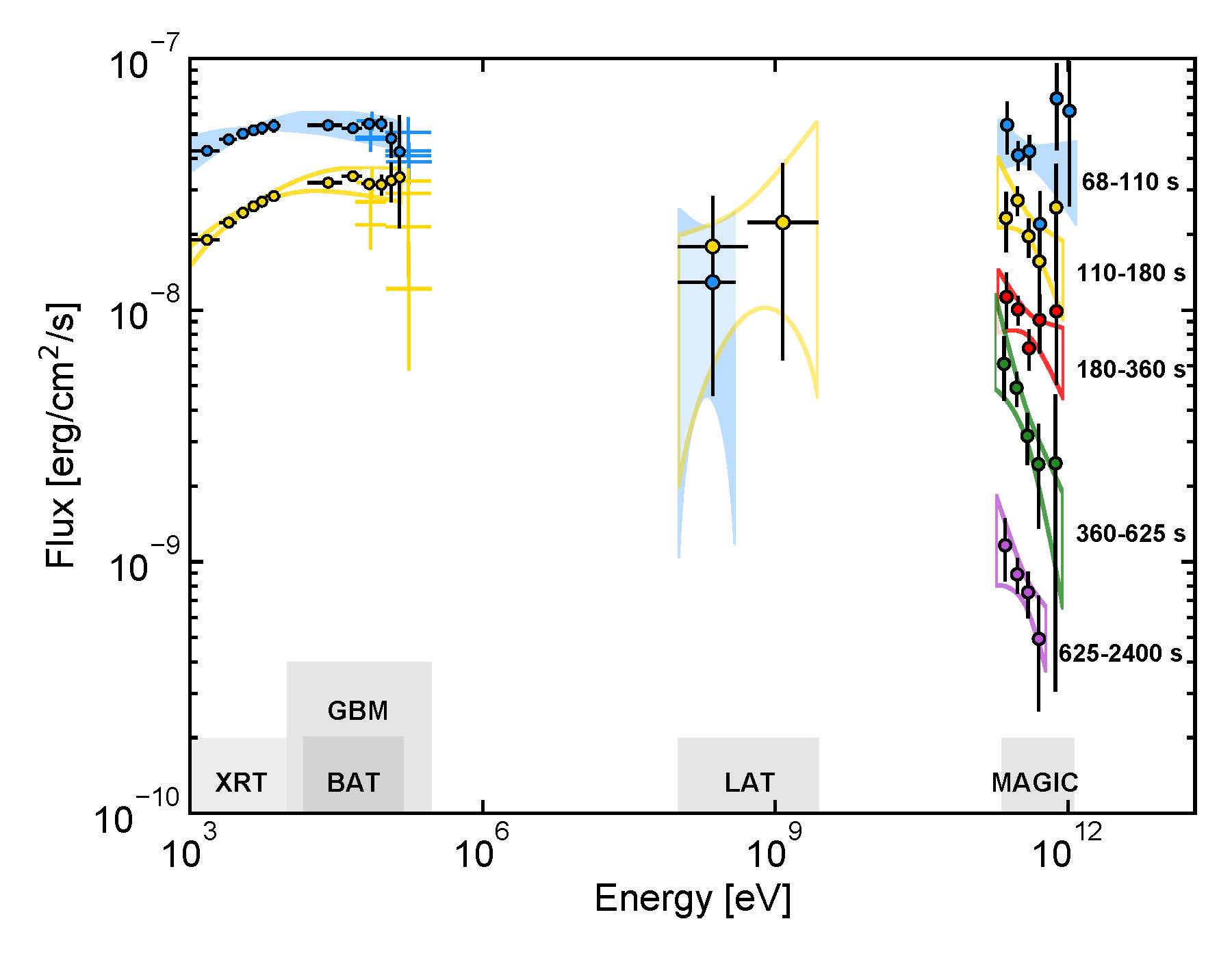
SED development of GRB 190114C in time measured by Swift XRT/BAT, Fermi GBM/LAT and by MAGIC. The MAGIC measurement is split into 5 consecutive periods of time. For the first 2 time bins also the data from the mentioned satellites are shown.
Mirzoyan:
The first measurements show that the afterglow of GRBs is accompanied by the second peak in its spectral energy distribution (SED) at (sub-)TeVs, resembling much the blazars. And this second Synchrotron-Self-Compton (SSC) is pretty energetic, it has a power comparable to that of synchrotron emission at lower energies. This means that until the recent past researchers were missing a substantial part of energy from the GRBs and that these are more powerful than thought before. The presence of the 2nd peak will help us to constrain and pinpoint many physical parameters of GRB jets and of the surrounding medium. We made a significant step towards improving our understanding of GRBs.
Wagner:
Not all GRBs are alike and it is not credible to claim a unique common picture based on two different observations of two different bursts. The interpretation of the GRB180720B data is not straightforward. Both, a standard synchrotron and a standard synchrotron-self-Compton are difficult to reconcile with the data.
And is it relevant to have seen both the prompt and also the after glow emission with respect to the models?
Mirzoyan:
Only a wide field of view (FoV) instrument can observe a GRB in its prompt phase. The narrow FoV instruments like Imaging Air Cherenkov Telescopes (IACTs) also in future would rely on satellite mission alerts on GRBs. MAGIC observation of GRB 190114C started at 58 seconds after the onset of the GRB, so although this should be the in the afterglow phase, a small contribution from the prompt phase cannot be excluded. Our modelling indicates that about half of the radiative output of the GRB 190114C is emitted in the prompt emission phase and the other half in the afterglow phase. The afterglow contains a wealth of information on the interaction of the relativistic jet launched by GRB with the ambient medium. Of course it would be fantastic to observe a GRB in its prompt phase with a ground-based instrument, which covers, for example, an area in excess of 25000 m² (HAWC, LHAASO); the initial rate of gammas would be so high that one needs to carefully design the DAQ system, for preventing its saturation. Observation of the prompt phase with its structured signal at TeVs could provide additional important clues like, for example, to processes when and how a jet is launched and expands, for unravelling the sequence of the complex processes happening at the initial phase of the bursts.
Wagner:
It is extremely important to cover GRBs during the prompt and the afterglow phases. We would have profited a lot from observations of the prompt phase of GRB180720B or longer-lasting observations of GRB 190114C. The two bursts are different and the two data sets do not lead to an unambiguous common scenario. We will need to observe many more bursts in more detail to fully understand the mechanism giving rise to the VHE emission.
Was it a coincidence that both experiments achieved this result at about the same time, or did the technology develop in such a way that such measurements are now feasible and we will be able to measure GRBs more frequently in the future?
Mirzoyan:
The question that in the past year we frequently asked ourselves is why it took so long, say 15 years, to measure a gamma-ray signal from a GRB at TeV? The first answer is that these happen not so frequently at relatively low red-shifts. It is well-known that the strong EBL (extragalactic background light) absorption limits the reach of IACTs at high energies; for example, we estimated that the 1 TeV emission from the GRB 190114C, residing at the red-shift of 0.42, is attenuated by 300 times. The second answer is that the probability is higher that these will happen at large zenith angles (i.e. at energies much higher than the threshold of a given ground-based instrument); one needs to correspondingly plan the reaction of instruments to alerts. The third reason is that one needs to observe a GRB at any, even at barely acceptable ambient lighting conditions, once it is relevant; this further enhances the chance probability. And the last but not least answer is that one needed to show in the first time that in fact, it is do possible to measure a (sub)-TeV signal from a GRB and this is just what MAGIC did. The good thing is that the GRBs will become regular observational targets at (sub)-TeVs and soon the successful measurements will provide wealth of data allowing us to find clues to many puzzling questions about these monstrous explosions.
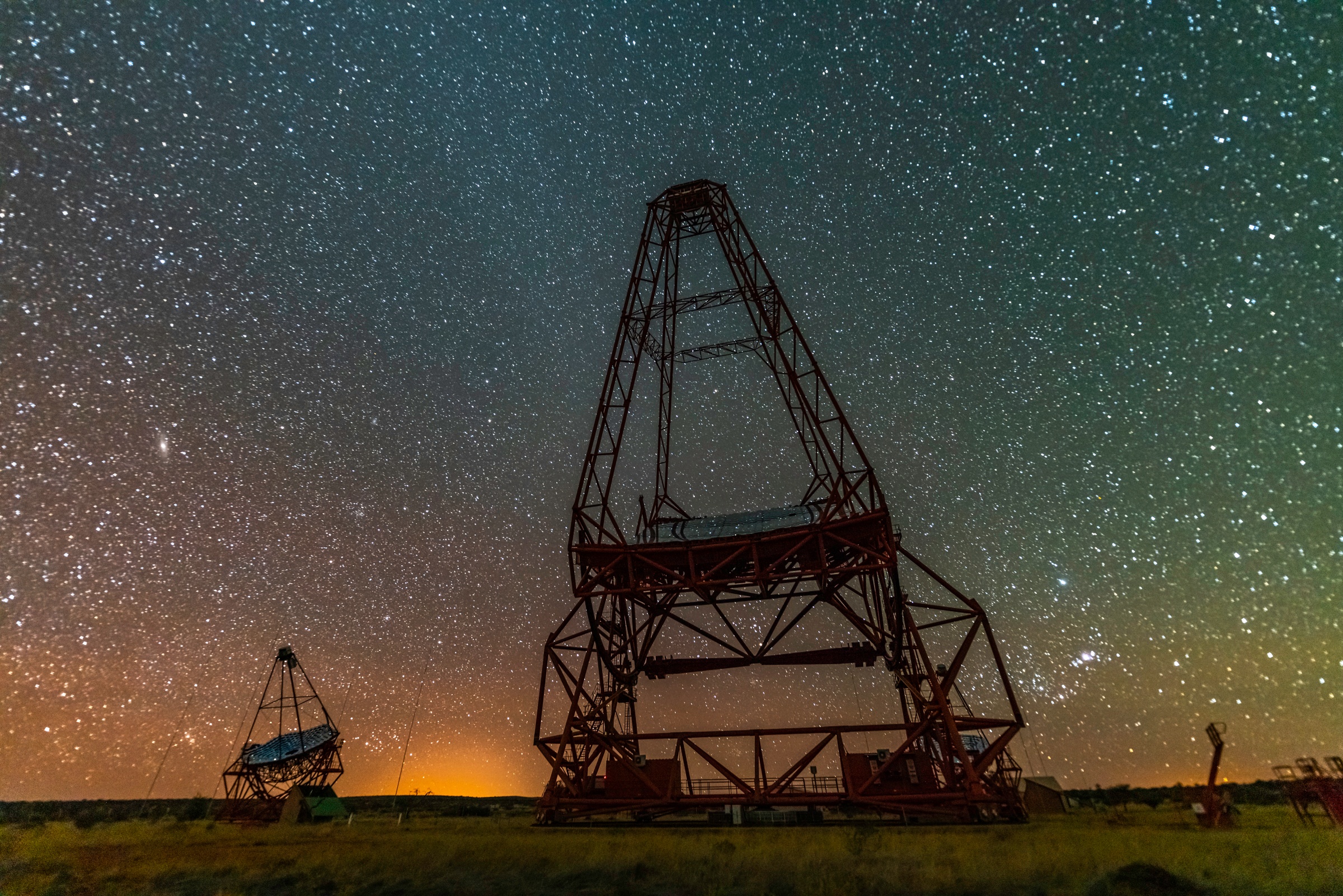
The giant CT5 telescope of the H.E.S.S. array. With its 28m lage main mirror it is by far the largest Cherenkov telecope in the world. Its light gathering power was instrumental for the discovery of the first GRB ever discovered in the VHE band – GRB 180720B. Credit: HESS/Vikas Chander
Wagner:
GRB180720B was an extraordinarily bright burst. Our GRB alert scheme would have identified such an exceptional burst many years earlier and we would have aimed for follow-up observations in case the position of the burst in the sky and weather conditions would have allowed observations. The discovery would have been possible earlier, but such bright bursts are rare. Given the delay of 10 hours after the event before the position in the sky became observable, the CT5 telescope, which started operations about 5 years before GRB180720B, was essential. The technology continuously advances, and the rare GRBs have always been a much sought-after target in the entire community such that any improvement raises the likelihood of successful observations. We are hence optimistic that we will be able to measure GRBs more frequently in the future. As with any rare and unpredictable event, however, one needs to be prepared, alert, – and lucky.
At what point were you aware that you had actually detected GRBs and what are the verifications you needed to do from detection to publication?
Mirzoyan:
We got convinced that in fact MAGIC has measured a monstrous strong signal >20 sigma from GRB 190114C within the first two hours after the alert from the Swift satellite mission, in the late evening of 14th January 2019. In the next morning, while sitting in the plane aiming to Tucson, I was surprised to see ten (10) analyses results, performed by the collaboration members from Spain to Germany, from Italy to Japan. The reported signal strength were in the range 40-60 sigma (this value depends on the used cuts). From that moment on we started carefully evaluating the systematic errors related to our detection. So essentially we looked into diverse technical issues for carefully evaluating the systematic errors. There were no problems related either to signal strength, statistical errors or remaining background (the latter was really negligible). We spent a lot of time for coordinating exchange of data with about two dozen space-born and ground-based instruments, which observed the GRB 190114C, for developing our model of the GRB afterglow emission.
Wagner:
We knew from the start that GRB180720B is an exceptional burst. The information in the initial trigger information clearly identified it as an unusual bright GRB even before the position became visible for H.E.S.S. and this information was folded in when the observational strategy was set. Nonetheless it was a rather faint signal which did not allow an unambiguous detection during the observations. Any H.E.S.S. result is cross-checked using different analyses and flaring events – which cannot be re-observed – require careful control of the trial factors in the analysis. Given the X-ray brightness of the prompt burst it was clear that even an upper limit would provide important constraints and we used a dedicated unblinding procedure for off-line analysis in the weeks following the event. The verification of the analysis and final publication goes much beyond the mere detection and involved spectral and temporal analysis.
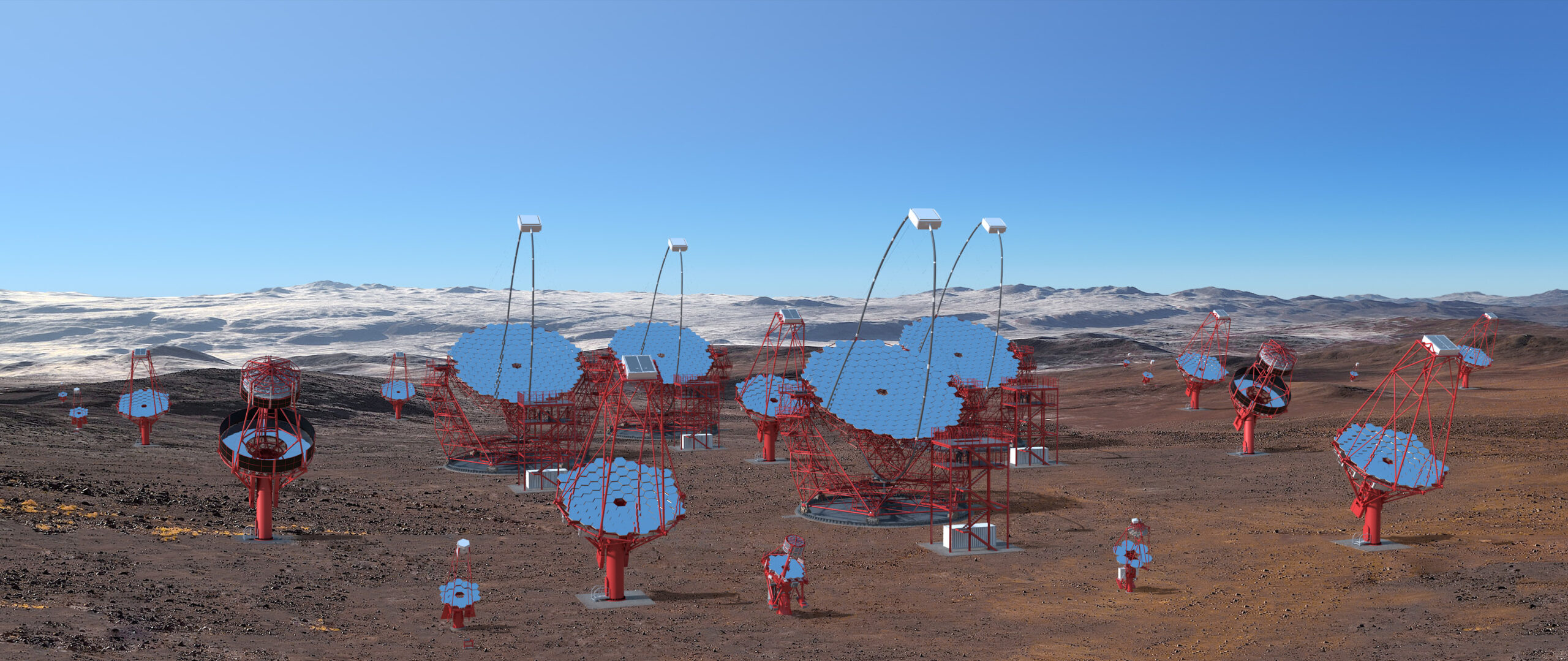
Future CTA Telescopes – This image illustrates all three classes of the 99 telescopes planned for the southern hemisphere as viewed from the centre of the array. While not an accurate representation of the final array layout (the smallest telescopes will be spread just beyond the centre), this rendering illustrates the enormous scale of the CTA telescopes and the array, itself. Credit: Gabriel Pérez Diaz, IAC / Marc-André Besel, CTAO
What do you expect from future experiments like CTA?
Wagner:
GRBs have been one of the key motivations when designing CTA and it is reassuring to see these discoveries now. Some of us started to worry about not having detected GRBs despite the more than decade-long searches with H.E.S.S. and MAGIC. In our discovery paper we address CTA perspectives and estimate that we should detect one GRB with CTA every 4 months on average and be able to observe the afterglow for about 10 bursts every year.
Mirzoyan:
I expect that already the current generation of telescopes will measure a solid sample of GRB emissions in the afterglow phase. The future will become only better with operation of the large number of well-designed and optimised CTA telescopes. One may anticipate that due to the higher sensitivity the CTA telescopes can find fainter GRB emissions and possibly in rather late phases of their emission. The very low threshold of the telescopes will probably not play a decisive role because the GRBs will mostly happen under large observational angles, well above the threshold. Of course it is very much desirable to have a threshold as low as few tens of GeV; this could help to observe the population of GRBs from beyond the red-shift of 1. I anticipate that within the next 10 years we will gain a very solid knowledge on the GRB afterglow and maybe with a piece of good luck in a few cases, also on the prompt phase.
A very-high-energy component deep in the γ-ray burst afterglow; The H.E.S.S. collaboration; Nature, 2019;
DOI: 10.1038/s41586-019-1743-9
Teraelectronvolt emission from the γ-ray burst GRB 190114C; The MAGIC collaboration; Nature, 2019;
DOI: 10.1038/s41586-019-1750-x
Observation of inverse Compton emission from a long γ-ray burst; The MAGIC Collaboration; Nature, 2019;
DOI : 10.1038/s41586-019-1754-6
Razmik Mirzoyan
Stefan Wagner
Dr. Razmik Mirzoyan is an astro-physicist, since 1992 working at the Max-Planck-Institute for Physics in Munich, Germany. He is currently the spokesperson of the MAGIC collaboration and the EU spokesperson of the TAIGA collaboration. His main interests are in astrophysics, astro-particle physics, cosmic and gamma rays, cosmology and in photon sensors. He defended his PhD thesis in FIAN in 1984. Since then he is working in the ground-based very high energy gamma-ray astronomy with imaging air Cherenkov telescopes (IACT). He is one of the founders of the HEGRA IACT array (1991-2002) as well as the co-founder of the MAGIC IACTs (2003- till now). He has made strong contributions in fast photo sensors as the classical PMTs, SiPMs, Hybrid Photo-Diodes, significantly improving and boosting their performance. He is co-authoring 15 patents in EU and in a number of foreign countries. He is a honorary professor of Irkutsk State University and a foreign member of the National Academy of Sciences of Republic of Armenia.
Prof. Stefan Wagner is a professor for astrophysics at Heidelberg University and Co-sokesperson of its IMPRS graduate school on astronomy and Cosmic Physics. Having worked mostly of active galactic nuclei he is very much engaged in multi-wavelength studies of non-thermal sources and time-domain astronomy. He co-founded the H.E.S.S. experiment, has coordinated its multi-wavelength working group for many years and is the current director of the H.E.S.S. facility and spokesperson of the collaboration. He has been responsible for CTA governance and hosted the international CTA project office during its design phase.
Interview with Anatael Cabrera on the development of an opaque scintillator.
In this issue we would like to give Anatael Cabrera the opportunity to present his new development of a liquid scintillation detector — “LiquidO”. In contrast to established scintillators, which are transparent, LiquidO consists of an opaque scintillator and a dense array of fibres. Anatael Cabrera will tell us more about it:
Can you briefly explain the idea behind LiquidO? What is the difference between this detector and the established scintillators?
LiquidO is essentially an evolution of the popular scintillator detectors pioneered by the Reines (et al.) in the 50’s for the neutrino discovery. Their approach used transparency so that the light emitted upon
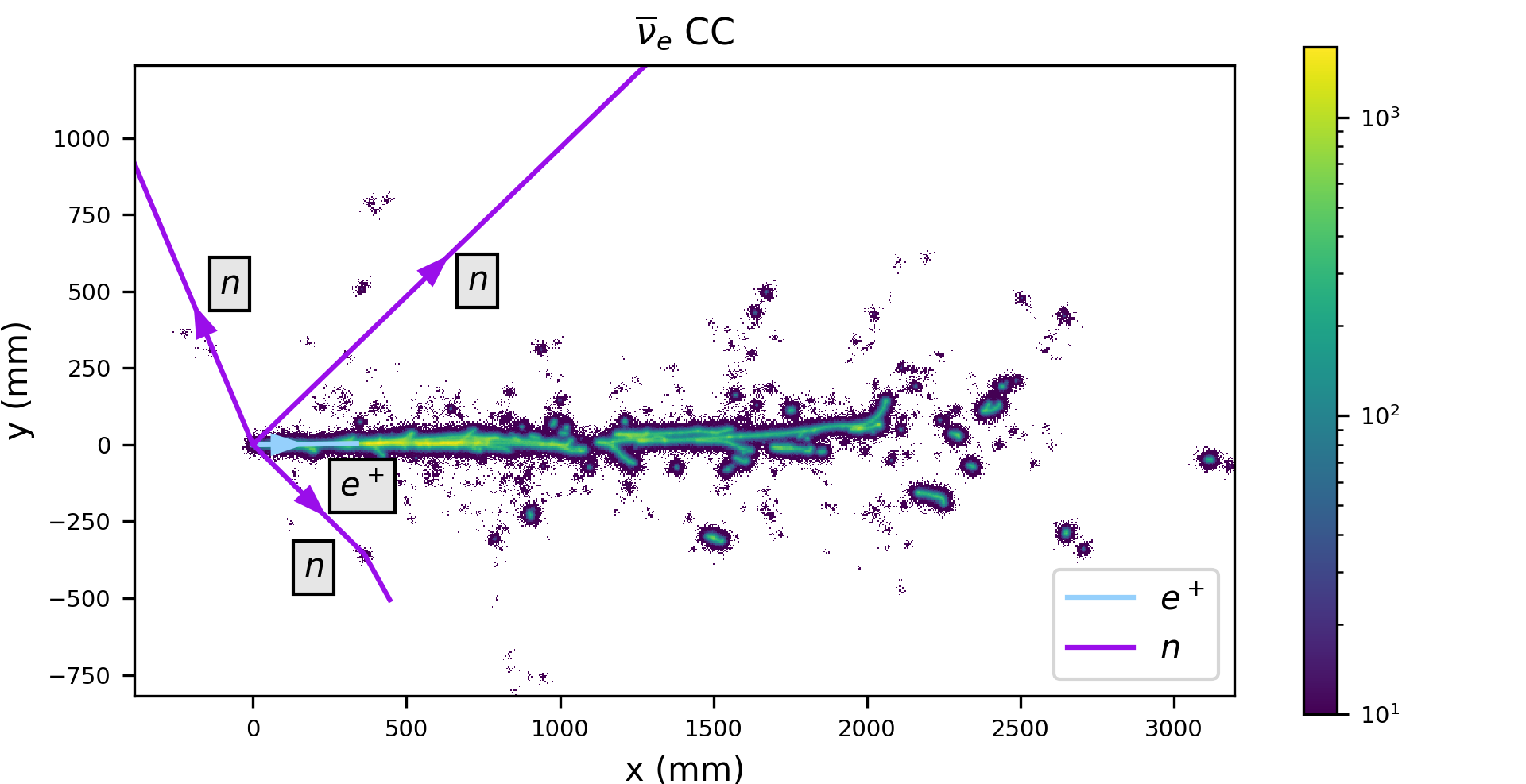
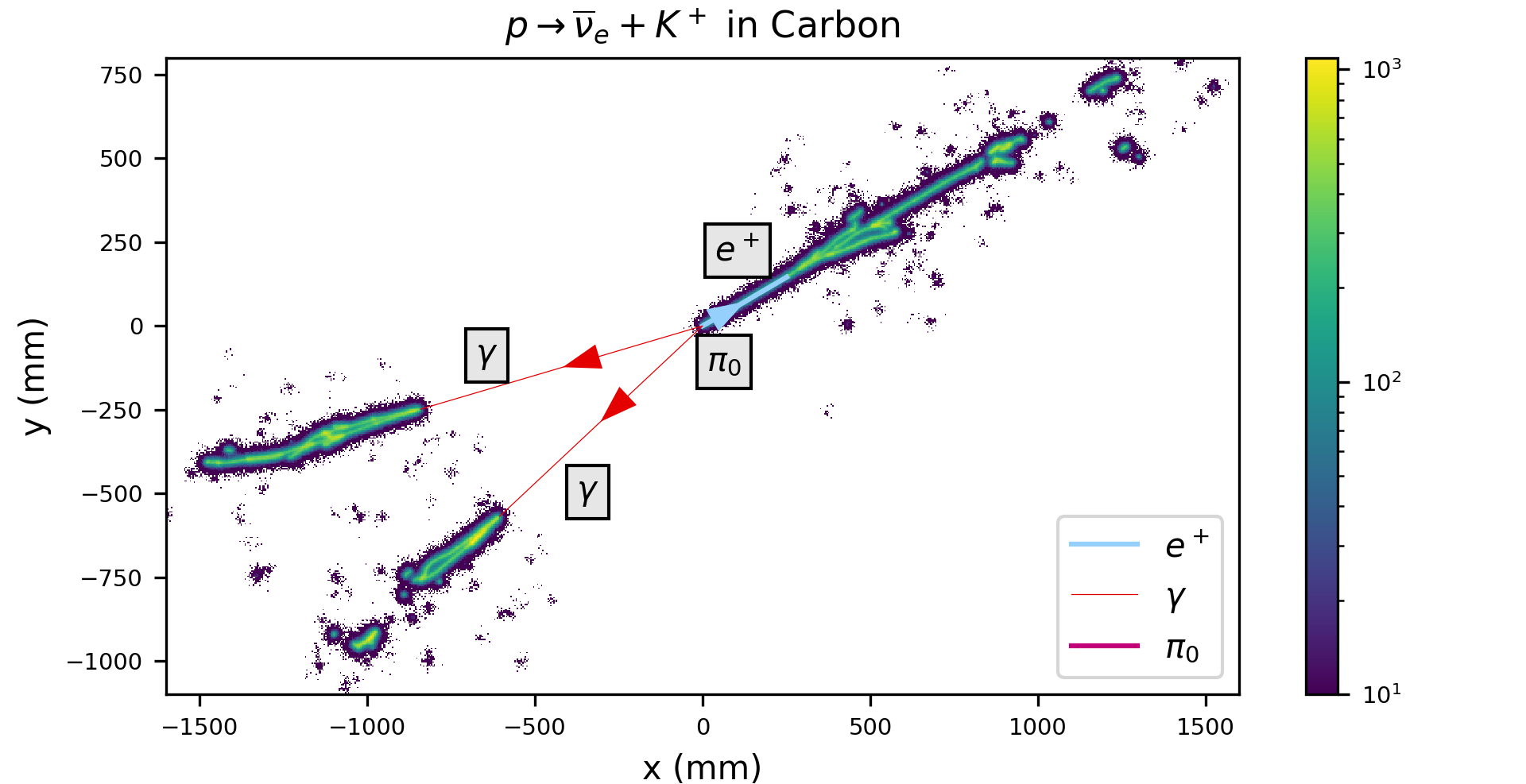
neutrino interactions is detected by photo-sensors located up to some meters apart. Their detection principle shaped much of the neutrino detection technology since. Instead, LiquidO breaks with the need for transparency to, ironically maybe, allow for unprecedented sub-atomic particle imaging based on scintillation light for the first time. Counter-intuitively, light diffusion is used to sharpen otherwise blurred patterns, as optical photons are stochastically confined locally to each particle energy deposition. The level of detail is at first glance spectacular. For example, one could recognise the annihilation of anti-matter, such as a positron (e+), even with negligible kinetic energy as illustrated in figure 1.
Figure 1: The back-to-back pattern is due to the two γ-rays (511keV) obtained upon the annihilation of a positron (e+), whose imaging could be exploited to tag low energy anti-neutrino CC interactions and medical practical applications in the PET scanner instrumentation. Each point represents a fibre, pitched 1cm apart. The colour code is proportional to the number of photons hit per fibre, while in today’s technology, the photon detection efficiency is ≤5.0% (~1/20x less). All other event-displays are done using detected photons. However, today, the light level is subjected to possible optimisations, particularly envisaged for energy deposition <1MeV.
This imaging allows, in turn, event-wise particle identification for the first time in liquid scintillator medium up to the MeV in energy. This game-changing capability may help us impact much of today’s neutrino detection paradigm. For example, we might reduce our dependence on passive shielding, including deep overburden in underground laboratories to yield major background rejection. Besides, the light opaque medium offers a relaxed optical scenario enabling us to consider both new scintillation technology — first explorations are ongoing — and the ability to accommodate large doping levels, boosted by up to one order of magnitude relative to today’s state of the art. Altogether, LiquidO seems to offer a novel detection framework inheriting many feature from the well known scintillation detection legacy while capable, should performance allows, to seed some degree of revolution in some physics channels.
You also illustrated your idea in a poster at the JENAS 2019, the Joint ECFA-NuPECC-APPEC Seminar. Could all the three disciplines benefit from the new technology?
I think so. Let me suggest two examples below.
First, LiquidO was born in neutrino physics; a subject historically bridging across particle, nuclear and astro-particle physics domains like very few. A concrete example is laid by our most recent studies, where the potential of LiquidO for GeV neutrino physics have been explored. This was first presented in November 2019 in the context of the DUNE experiment. A LiquidO detector there could play a competitive role in particle physics via the first explorations of leptonic CP-violation. Neutrinos, in turn, are unique probes to challenging nuclear physics where LiquidO may offer new handles — under active study — aimed for the better control of systematics and background recognition. Our preliminary studies suggest that LiquidO may yield comparable topology to the exquisite liquid-argon TPC detectors. We have identified even some unique additional but complementary features, as illustrated in FIG II. In such a large detector located far from reactors, even the first explorations on 40K geo-neutrinos may be considered for the first time, see here, thus providing unique insight to our understanding of our planet, that might draw other general lessons in the context of astro-physical planet formation and dynamics.
Second, there appears an increasing number of cases where LiquidO might offer a rich detection framework beyond neutrino and rare decay. Since, I am far less of an expert, I’d just quote a few examples. Some colleagues are interested in calorimetry and search for rare particles in HEP colliders, thus exploiting LiquidO’s calorimetric-tracking ability and its high duty-cycle. This might benefit LHC or future FCC/ILC programmes. Even, possible societal/industrial applications, such as medical and reactor nuclear industry, are under active consideration. Our teams are exploring LiquidO as possible technology for a full-body PET scanners and remote reactor monitoring — a topic of high interest to the IAEA in the context of non-proliferation.
Which experiments may benefit from the LiquidO technology?
Figure 2: An electron neutrino CC interaction is illustrated, where the detected light is coloured coded. The leading lepton (e±) undergoes an electromagnetic shower. A halo of low energy depositions, including e+ annihilation, surround the shower. An outgoing track (π±) decays into a μ± when stopped. An energetic neutron (n) is also ejected from the interaction point. The n is recognised from the proton-recoil ionisation and its energy can be measured via time-of-flight.
Well, the more we study LiquidO, the more it appears this question may have more answers than we originally suspected. Although LiquidO was forged in reactor neutrino brainstorming, it appears surprisingly versatile beyond. Personally, I think that its ability to handle low MeV is most precious, even boosting its ability to handle higher energies with rich details, as shown in figure 2. Besides, the neutrino MeV range is rich in challenges, including many neutrino sources, such as the sun, the Earth, supernovae, reactors and decay at rest beam neutrinos. Today, much of our effort is devoted to address your question, where several publications are envisaged or even under preparation. We keep careful track of the physics to design and target the critical ongoing detector R&D — always limited by our very humble resources, specially manpower.
Figure 3: The most explored p→π0 + e+ proton decay channel is illustrated. The decay kinematical back-to-back pattern is expected, where the π0 decay into two γ’s is particularly clear thanks to the low density and long radiation length of LiquidO. The e+ electromagnetic shower can also be observed. The full pattern provides a strong event-wise rejection to possible background cases with high efficienc
As of today, our main studies, so far, had brought us to consider two main potential experimental topics — leptonic unitarity and high mass ββ decay searches. These subjects are renown for their possible discovery potential beyond our successful Standard Model of Particle Physics. While still early, the first feasibility publications are materialising shortly with very promising results. A remarkable research potential beyond today’s reach seems attainable. The observation of leptonic unitarity violation would imply the direct manifestation of new physics via the existence of non-standard neutrino states and/or non-standard interactions — either way, a breakthrough. Likewise, the positive observation of the neutrinoless double beta decay might reveal the deepest nature of the neutrino itself for the first time, including direct and unique sensitivity to its absolute mass scale. The first project was first presented in the EPS-HEP conference (July 2019), where we highlighted the potential to improve the precision on θ13 by almost one order of magnitude. We have developed a full strategy employing reactor neutrinos with a 10 kton LiquidO detector located at Chooz (France), thus the historical Chooz remains one of the best reactor sites in Europe. This hypothetical project, called for now “Super Chooz”, offers an additional uniquely “open sky” research programme, including proton decay as well as supernovae and solar neutrinos detection. LiquidO may excel in the proton decay discovery potential, as illustrated in figure 3. Whereas unprecedented explorations of the sun, and even supernovae, neutrinos may be possible via interactions on doped indium (Raghavan 1976), leading to a robust coincide signature for detection. Although indium based detection has never seen light in an experiment, much of the past groundbreaking R&D demonstrated that large doping levels (order 10%) are feasible. The second project was however first hinted in the NOW-2018 conference (September 2018) and a publication is in preparation. These ambitious experimental goals have so far encounter no evident scientific showstopper. However, we are looking forward to further pushing our detector performance quantification for consolidation in feasibility. While more challenges will surely be ahead, today I can tell that the background control for the ββ programme is one of the most extreme requirements so far.
Have you already gained some experience with the new detector or is it all based on simulations?
First prototype of the LiquidO detector.
Indeed, the experimental validation was, for me, a critical necessary condition to disclose LiquidO, conceived around 2013 but otherwise kept secret till the materialisation of its robust proof-of-principle. Until then, “it looked too good to be true”. Ironically, since LiquidO inherits from the well known scintillation detection, the addition of light scattering may have appeared as a trivial extrapolation. And while it may well be true, the new powerful imaging goes so far beyond today’s performance — and intuition — that dedicated experimental demonstration was highly desirable to ensure performance beyond surprises. This was achieved between mid-2018 and early-2019 using a “tiny” 0.25 litre prototype. The data was easily obtained with our new opaque scintillator (see Novel Opaque Scintillator for Neutrino Detection), but much thinking, extra support laboratory measurements and simulations aided the final corroboration, thus succeeding our first unambiguous experimental proof-of-principle. Since then, we have found no evidence whatsoever of any inconsistency to our scattering dominated model. Hence, LiquidO was decided to be officially released in June 2019 along with our first publication (see LiquidO: Novel Opaque Neutrino Detection Technology and Neutrino Physics with an Opaque Detector).
What are the next steps you have planned?
In 2020, we expect the culmination of our small prototype based R&D and much of the ongoing physics prospect explorations. This should lead to several beautiful publications. Beyond that, we believe neutrino based data is needed to sizeably proceed and yield final consolidating demonstration. Hence, we aim for a few tons full scale demonstrator LiquidO detector to yield accurate performance quantification for physics feasibility. While scaling always entails somewhat a step into the unknown, the experimental programme proposed enables demonstration via leading measurements in the context of neutrino detection and ββ-decay background sensitivity hosted in two European underground laboratories. This programme, proposed in Europe, is led by four principal investigators, including spokespersons from 3 experiments and the extra support by the recently formed LiquidO proto-collaboration and cooperators. We are ready to proceed, as soon as the funding comes along.
Anatael Cabrera is a neutrino physicist since 2001 when he started his DPhil degree at the University of Oxford (UK) within the MINOS experiment. He is currently CNRS/IN2P3 scientific staff at the Linear Accelerator Laboratory (Orsay, France). Since 2014, he is director of the underground LNCA laboratory (Chooz, France). He is currently spokesperson in the Double Chooz and also supports the JUNO experiment, where he led the co-coordination of the JUNO electronics/trigger system. In 2015, he conceived, proposed and co-coordinates since the Dual Calorimetry system aimed for extra high precision calorimetry control and its dedicated physics programme. Around 2013, he conceived the LiquidO detection technique. Today, LiquidO stands as an international scientific project supported by a proto-collaboration. He is co-spokesperson of LiquidO along with Prof. F. Suekane (RCNS/Tohoku University, Japan).
Interview with Christian Weinheimer on the recent publication of the first KATRIN results
The long awaited science run at KATRIN took place in spring this year. On Monday, 16th of September the analysis results were finally presented during a Colloquium at KIT: An upper limit for the neutrino mass of 1.1 eV was found and, maybe more important, it was shown that this complex experiment is working properly. In the following interview Christian Weinheimer is sharing his view on the impact of these results.
KATRIN has just released results in a presentation and a paper now in the archive. This is extremely important since you could derive a model independent limit to the absolute mass scale of neutrinos which are at least a factor of 2 better than previous results.
Can you explain to the non-experts the meaning of your result and the impact on cosmology and particle physics itself?
Let me stress that the most important outcome of this first 4 weeks science run of KATRIN is that the experiment is working, it has started neutrino mass measurements and we understand the data. Much more is going to come in the near future.
Concerning the importance for particle physics and cosmology: In contrast to analyses of cosmology data from CMB and LSS et al. or the searches for neutrinoless double beta decay, the KATRIN result is a model-independent result from the lab. It constrains neutrino masses and the contribution of neutrinos to (hot) dark matter (and the corresponding consequences for structure formation in the universe) by a factor two more stringently than before. Of course we know that the limit from cosmological analyses are much stronger than the present 1.1 eV limit from KATRIN, but they are not free from model assumption. There is still the not entirely satisfactory situation, that in these cosmological analyses the major part of matter is parametrized as cold dark matter, but we have not discovered the nature of dark matter yet. And, there are still some frictions in cosmology data, e.g. the exact value of the Hubble constant H0.
This result sets a milestone after only 4 weeks of measurements for leading in about 1000 days to a possible limit of 0.2 eV (90%CL).
From having reached the present result after 4 weeks only, one might expect to reach the 0.2 eV sensitivity even early. Unfortunately it will not go fast. We are sensitive to the observable m2(ν). To go from 1 eV to 0.2 eV requires a factor 25 improvement of the experiment. Therefore we expect to reach the KATRIN design sensitivity after 1000 days of measurements. We will soon, i.e. still in September, start data taking with a factor 5-10 better signal-to-background ratio.
Overview of the KATRIN setup (Credits: Steffen Lichter, KIT)
What are the main experimental challenges in this measurement which you foresee?
The main experimental challenges of KATRIN is to operate the whole experiment very stable over long periods of time: It requires to run the windowless gaseous tritium source stable at the per milllevel w.r.t. temperature, gas inlet pressure and tritium concentration. The KATRIN pre and main spectrometer have to be operated at extremely good vacuum (1E-11 mbar) and at a ultrastable high voltage at the ppm (1E-6) level. The many superconducting magnets have to run smoothly and stable as well as our electron detector. In principle we have demonstrated that we meet all these requirements, but now all the complicated components have to work continuously for years in such a stable manner. I should emphasize that fulfilling the mentioned requirements was not easy at all. To make this all happen, in many cases the KATRIN Collaboration had to advance technology that now benefits the whole community.
The remaining challenges are to lower the background further and to control the plasma properties sufficienctly well. Here we are on a good way: We will take the next science data at lower background rate already and we demonstrated avoiding any radial dependence of the effective endpoint of the experimental beta spectrum by coupling the plasma potential to the rear wall of our windowless gaseous tritium source by adjusting the rear wall potential.
In your view, is there any scientific program which could lead to a measurement of the mass in the next 10 years?
Neglecting the limits from cosmological analyses, the neutrino mass to be seen in tritium beta decay can be any value below the present upper limit by KATRIN of 1.1 eV and 50 meV in the inverted neutrino mass ordering scenario, and 10 meV in the normal mass ordering scenario. Within KATRIN we have some R&D projects to improve KATRIN’s sensitivity further below the 200 meV, but the 10 meV with a guaranteed discovery potential seems to be out of reach. There is Project 8, still in the R&D phase, which aims on a sensivity of 40 meV using an atomic tritium source and determining the beta electron energy by cyclotron resonance electron spectroscopy. There is some hope to reach this 40 meV sensitivity within a decade, but it will be very challenging. And there are the projects to determine the neutrino mass with cryogenic bolometer arrays investigating the electron capture process of Ho-163. The current limit of the ECHo experiment amounts to 150 eV and will be improved towards about 10 eV soon with the potential to reach the sub-eV regime with larger detector array in the future.Therefore we have to be lucky to detect the neutrino mass with these direct methods within the next 10 years, but our community will certainly find a way to finally measure the neutrino mass in the laboratory.
Of course, most people expect neutrinos to be Majorana particles. The next generation of neutrinoless double beta decay experiments can cover a significant part of the above mentioned inverted mass ordering scenario within the next 10 years.
Christian Weinheimer (Credits: Beatrix von Puttkamer, KIT)
Prof. Christian Weinheimer is group leader at the Institute for Nuclear Physics at the University of Münster. Since 2001 he is involved in KATRIN and is, together with Guido Drexlin, spokesperson of the experiment. He is an expert in neutrino physics and already for his PhD he dealt with the neutrino mass. Besides he is involved in the search for dark matter and is member in the XENON100 and XENON1/nT as well as the DARWIN experiment.
Interview with Silvia Pascoli about the upcoming meeting and the roadmap on neutrinoless double beta decay
One of the recommendations on the neutrinos in the APPEC Roadmap sounds:
‘APPEC strongly supports the present range of direct neutrino-mass measurements and searches for neutrinoless double-beta decay. Guided by the results of experiments currently in operation and in consultation with its global partners, APPEC intends to converge on a roadmap for the next generation of experiments into neutrino mass and nature by 2020.’
Currently, APPEC aims to implement this recommendation. The adopted strategy for the future of neutrinoless double beta decay is the nomination of a panel, following the proposition by the SAC of a mandate document highlighting the panel duties, which was approved by the General Assembly in Granada on May 16, 2019.
The panel, is chaired by Prof. Silvia Pascoli (Durham U., UK) and it is composed by Andrea Giuliani (CNRS/IN2P3, France), J.J. Gomez Cadenas (DIPC, Spain), Ezio Previtali (Milano-Bicocca, Italy),Ruben Saakyan (UCL, UK), Karoline Schaner (GSSI, Italy) and Stefan Schönert (TUM, Germany). It is in charge of writing a document with a critical analysis on the technologies that Europe could pursue for establishing the new generation of neutrinoless double beta decay.
This document will be discussed and endorsed by the APPEC SAC until the APPEC Community Meeting on Neutrinoless Double Beta Decay in London, on October 31. There the inputs from the scientific community will be collected. Once the community comments are received and the document is updated, it will be discussed and approved by the APPEC SAC and General Assembly. The document will then be used in international fora to represent the Community view.
We briefly examine with Silvia the aim of the document and the meeting in London:
Silvia, you have provided an excellent service work to the community together with the panel by writing the 0νββ specific roadmap document and organising the APPEC Community meeting.
What scientific goal you see in the reach for the next 10 years?
Neutrinoless double beta decay plays a key role in the field as it is the most sensitive way we have to search for the violation of lepton number. This information is essential to hunt for the origin of neutrino masses. The next generation of neutrinoless double beta decay experiments will reach the decay rates relevant if the ordering of neutrino masses is inverted, covering a crucial area in the parameter space. I also do not discard the possibility of surprises as neutrinoless double beta decay is very sensitive to more exotic lepton number violating physics.
Which are according to you the major challenges that the 0νββ will have to face in this decade?
Neutrinoless double beta decay is an exceedingly rare process. The main challenges we face are the reduction of backgrounds to unprecedented levels and at the same time increasing the masses to the ton-scale. The community has devised new experimental ways to address this challenges and it is now the time to put them at work.
What theoretical and R&D efforts should we concentrate on to prepare for the successive decade?
From the knowledge of neutrino masses we have, we know that the predictions for the decay rates could be longer than the reach of the next generation of experiments, in particular if neutrino have a normal ordering of masses. This means that 10-ton scale experiments are needed with even further reduced backgrounds, ideally background-free, and excellent energy resolution. There are some preliminary ideas on how this could be achieved but substantial R&D is needed to turn these ideas into real experiments. On the theoretical side, an important aspect we need to make significant progress on is the computation on the nuclear matrix elements. New techniques are becoming available and we may be on the verge of a breakthrough. The collaboration with the nuclear theory community is essential for this purpose.
What do you hope for this community meeting?
Following a long tradition, Europe is playing a leading role in neutrinoless double beta decay with experiments such as GERDA, CUORE and NEXT. It is essential that this leadership continues in the future. It is an opportunity that we should not miss. To this aim, strong support is needed for this field, focusing on the most sensitive and most promising experiments. At the community meeting we plan to discuss the options for the next generation and to consolidate the wishes of the community for a strong European programme.
Silvia Pascoli is professor at Durham University. After getting her ‘laurea” in theoretical physics at the University of Trieste under the supervision of Antonio Masiero, she obtained her PhD at SISSA (Trieste, Italy) studying the properties of neutrinos with Serguey Petcov. She then moved to UCLA for her postdoc and then at CERN. Since 2005 she is at Durham University where she continues to work on neutrino physics, in all relevant areas, Theory, Phenomenology, Astroparticle Physics and more recently Cosmology. In 2016 she was awarded a Wolfson Research Merit Award by the Royal Society.
Silvia Pascoli is professor at Durham University. After getting her ‘laurea” in theoretical physics at the University of Trieste under the supervision of Antonio Masiero, she obtained her PhD at SISSA (Trieste, Italy) studying the properties of neutrinos with Serguey Petcov. She then moved to UCLA for her postdoc and then at CERN. Since 2005 she is at Durham University where she continues to work on neutrino physics, in all relevant areas, Theory, Phenomenology, Astroparticle Physics and more recently Cosmology. In 2016 she was awarded a Wolfson Research Merit Award by the Royal Society.
Interview with Paschal Coyle on the recent deployment campaign for KM3NeT
During the last month Paschal Coyle and his colleagues from the deployment team were busy installing additional Detection Units (DUs) in the Mediterranean Sea.
The most recent campaign was from 29th of June until 1st of July 2019 and since then the KM3NeT/ORCA deep-sea neutrino detector is continuously taking data with its first four neutrino detection units.
What is the current status in the two KM3NeT sites, in front of Toulon and Capo Passero?
KM3NeT is an ESFRI roadmap project aimed at constructing a neutrino telescope with sites in France and Italy. The project has the dual goal of high-resolution, multi-flavour neutrino astronomy and the study of neutrino oscillations in the GeV range to establish the neutrino mass ordering.
After some delays related to issues with the seafloor network, four DUs are now operational at the French site. The Italian site also hosts one operational DU, which has been working now for 3 years. The data from the first DUs have provided an important validation of the KM3NeT technology. In particular, we have demonstrated the capability to precisely position (less than 1 m) the detection units on the seafloor and measure the real-time position of the optical modules to a few centimetres using the acoustic positioning system. We have also confirmed that we can determine in real-time the in-situ time/gain/efficiency calibrations based on signals from the radioactive decays of the potassium isotope 40K present in the seawater. Combining data from both the ARCA and ORCA detectors we have recently published the depth dependence of the atmospheric muon flux over a depth of more than one kilometre (arXiv:1906.02704). At the ICRC 2019 conference we will present our first detection of atmospheric neutrinos with these DUs.
What are your future milestones?
With the advent of recent new funding in France, Italy and the Netherlands, the Collaboration currently has the means to build a total of about 100 DUs, along with the seafloor infrastructure to accommodate more DUs. At this moment, the optical modules for 20 DUs have been assembled; these will be deployed at the Italian site once refurbishment of its sea floor network will be completed summer 2020.
With several optical module and detection unit construction sites across Europe, the completion of the 115 (230) DUs for the French/ORCA (Italian/ARCA) sites could be achieved in 2024(26), assuming timely availability of the full funding. The Collaboration has also started the process to set up a legal entity in the form of an European Research Infrastructure Consortium (ERIC).
Deployment of the furled detection unit.
KM3NeT is an infrastructure that can be used in other fields of science– tell us about those activities.
The KM3NeT research infrastructure is also a cabled deep-sea marine observatory and will provide open access to instrumentation from the Earth and Sea science community. Until now, measurements in the deep sea are typically performed by deploying and recovering autonomous devices that record data over periods of months to years. This method is severely constrained by bandwidth limitations, by the absence of real-time interaction with the measurement devices and by the delayed access to the data. A cabled observatory like KM3NeT remedies these disadvantages by essentially providing a power socket and high bandwidth Ethernet connection at the bottom of the sea. This is an important and unique opportunity for performing deep-sea research by scientists from the fields of marine biology, oceanography, environmental sciences and geosciences. To this end, both the French and Italian KM3NeT sites are nodes of the European Multidisciplinary Seafloor and water column Observatory (EMSO).
For example, an EMSO sea science instrumentation module was recently connected to the KM3NeT-France infrastructure. This module hosts sensors that provide real-time monitoring of a plethora of environmental parameters including temperature, pressure, conductivity, oxygen concentration, turbidity and sea current. Soon additional instrumentation including a benthic crawler, a seismograph, a deep-sea Germanium gamma detector and a high-speed, single-photon video camera for bioluminescence studies will also be installed. Furthermore, the KM3NeT optical modules themselves provide invaluable data on deep-sea bioluminescence and bioacoustic monitoring of the local cetacean populations. A recent nice spinoff is the exciting possibility to use the optical fibres in the main electro-optical cables, that run for many tens of kilometre along the seafloor, for seismological studies via the technique of laser Distributed Acoustic Sensing (https://eartharxiv.org/ekrfy/).
We have now three major efforts in the world: KM3NeT and Lake Baikal with infrastructure located in countries belonging to APPEC, and IceCube at South Pole to which some European countries contribute. What are common activities? Do you think this cooperation could become a real network of detectors such as in the case for gravitational waves, namely LIGO and Virgo, who publish common papers?
In 2013, the Antares, IceCube, KM3NeT and Lake Baikal collaborations signed the Memorandum of Understanding for a Global Neutrino Network (GNN). This step formalised the already active cooperation between the different groups. Once infrastructures of similar scale are operational on the three continents, the stated aim of the GNN is a worldwide Global Neutrino Observatory. Within the framework of the GNN we have published a number of joint papers combining the data from ANTARES and IceCube resulting in improved limits on point sources and dark matter searches. A joint paper was also made on the follow up of the GW170817 gravitational wave alert. Furthermore, GNN organises yearly common meetings of the four collaborations and the biennual Very-Large Volume Neutrino Telescope conference (VLVnT).
Dr. Paschal Coyle is a Director of Research, CNRS, at the Centre de Physique des Particules de Marseille (CPPM). Since 2000 he has been involved in the ANTARES deep-sea neutrino telescope and during 2008-2014 was the Spokesperson of the Collaboration. He was the Deputy Spokesperson of the KM3NeT Collaboration (2013-2016) and is currently the Physics and Software Manager of KM3NeT.