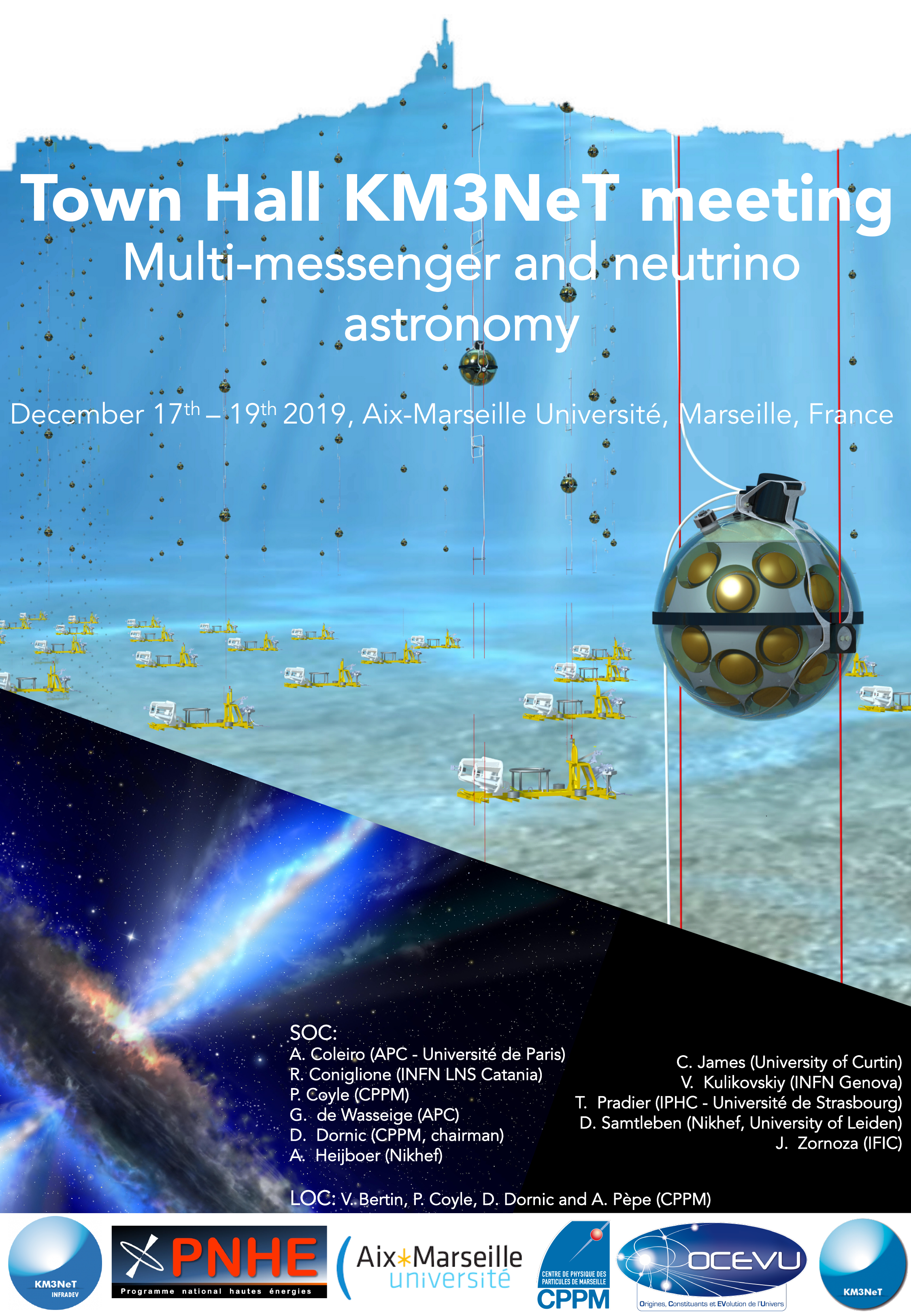
The KM3NeT Collaboration is organizing a Town Hall Meeting to promote its multi-messenger programs. The workshop will take place from 17-19 December 2019 at the Aix-Marseille Université in Marseille, France. During this workshop, they would like to review the most up-to-date neutrino production models and present KM3NeT performances and multi-messenger programs.
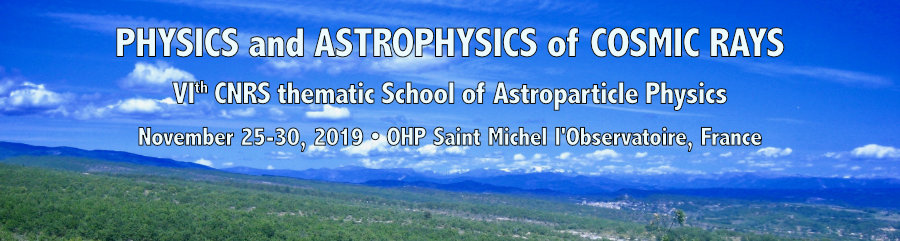
The VIth CNRS thematic School of Astroparticle Physics on “PHYSICS and ASTROPHYSICS of COSMIC RAYS” will be held from November 25th – 30th 2019 at the OHP Saint Michel l’Observatoire in France. This school follows several other schools supported / organized by the Programme National Hautes Energies (PNHE), the latter focusing on the physics of the Universe X-ray (2016), gravitational waves (2013) and gamma astronomy (2011). This one will present an observational and theoretical overview of the physics and astrophysics of cosmic rays, with hands-on training sessions on Cherenkov Telescope Array (CTA) data analysis as well as on CR propagation codes. Particular attention will be given to taking into account statistical and systematic errors in both measures and theoretical models. It will enable current and future actors in the field to understand the various transverse aspects, such as the very great importance of multi-messenger and multi-wavelength observations for understanding the key physical mechanisms in acceleration and transport. Opening up to a broader scientific community, this school aims at bringing together specialists on these topics with the aim of training the next generation of young researchers, in addition to transfer/share skills.
The Gravitational Wave Probes of Fundamental Physics (GW4FP) workshop will take place from 11-13 November at the Volkshotel in Amsterdam, The Netherlands.
As the first workshop by the European Consortium for Astroparticle Theory (EuCAPT), GW4FP aims to bring together the Gravitational Wave and Fundamental Physics communities to discuss topics in Dark Matter, exotic objects, tests of GR and early Universe physics, as well as tests of Standard Model physics in unexplored regimes.
The workshop will involve invited plenary talks covering these broad areas as well as shorter submitted talks for researchers to present their work. Since a key goal of the workshop is to foster collaboration, there will also be discussions, lightning talks and a “four corners” discussion session.
The Paris-Saclay AstroParticle Symposium 14 October – 8 November takes place at the Institut Pascal of the Paris-Saclay University. Around 30 specialists of astrophysics, cosmology and particle physics are invited to discuss and work on the themes: Dark Energy and Dark Matter. Besides the working sessions, there will be also an Open Program with specific workshops, colloquiums and general public talks.
The High Energy Physics Software Foundation (https://hepsoftwarefoundation.org) is a community that intends to facilitate cooperation and common effort in software and computing internationally. In this context, a first discussion after the JENAS meeting is being organized to discuss common grounds on software challenges across the different communities of particle physics, astrophysics, neutrino physics and nuclear physics.
The meeting will be at LAL and on Vidyo on the afternoon of Wednesday October 16 at LAL, at 16:00-17:30, with agenda and videoconference coordinates here: https://indico.cern.ch/event/852242/
The discussion will start with a short introduction from Graeme Stewart, the coordinator of the HEP Software Foundation, presenting what the HEP Software Foundation is and what it facilitated so far. Then there will be contributions from the astrophysics, neutrino physics and nuclear physics communities, with time for discussion. This meeting is a first step to start a discussion on possible areas of collaboration in topics from software event selection and reconstruction all the way to data analysis that can continue in future occasions.
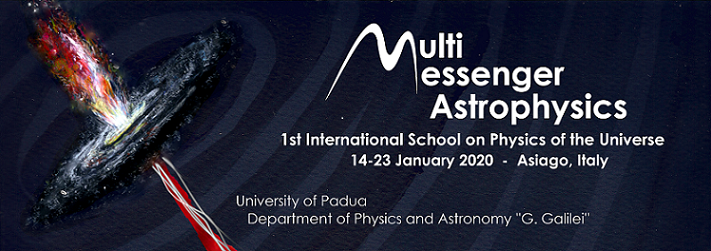
This first edition focuses on Multi-Messenger Astrophysics. These past two years were marked by huge advancements in this field, with countless invaluable results such as the detection of first gravitational waves, also in correspondence with photons, as well as the simultaneous observation of photons with a 300 TeV neutrino from an active galaxy. The foundation of high energy astroparticle physics are shaken and new theoretical buildings are raised. This calls for additional focused experimental efforts, with careful planning of multi-wavelenght and multi-experiments coordinated observation, specially when pointing telescopes with limited field of view are involved.
This school aims to recall the cosmology and particle physics background needed to seriously frame the discussion about multi-messenger signatures. The school will be organized with key lectures, plus a series of topical lectures and seminars. Exercises will be organized throughout the school on all topics. Hands-on will be organized on a selection of codes. The school will be closed with a final exam for self-evaluation.
The school will be international and it will be held in the beautiful curtains of the Asiago plateau, where the DFA astronomical observatory is located. The observatory is currently hosting two 1m-class telescopes hosting several instruments.
Participants will be limited to 36 and selected on the basis of their CV and a reference letter.
Deadline for support request and for Visa request: November, 8 2019.
Deadline for registration: December 8, 2019.
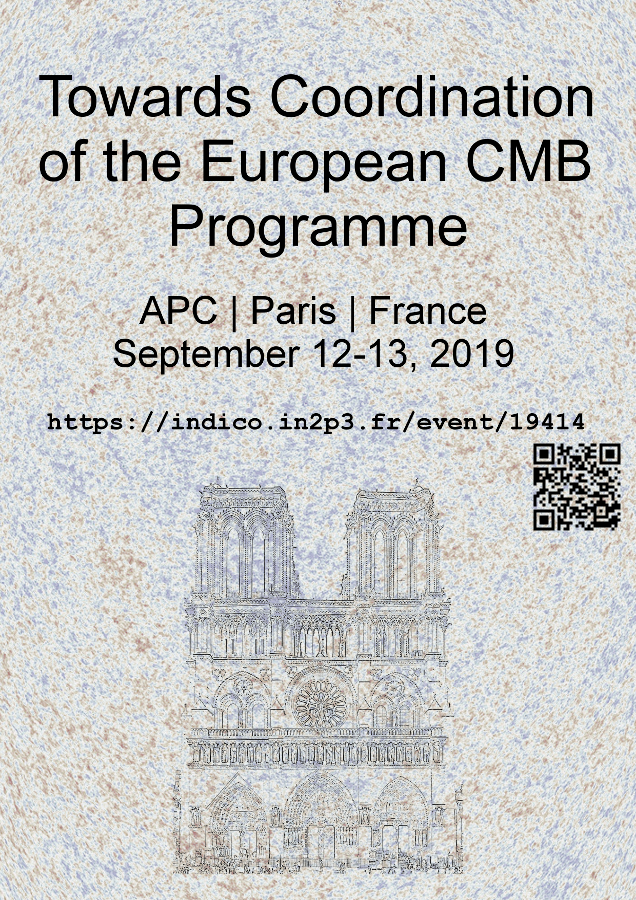
The meeting “Towards the Coordination of the European CMB program”, September 12-13, 2019 at the AstroParticle/Cosmology (APC) Labs in Paris, France, will gather experiment builders, observers and agency representatives in a continuing effort to chart the necessary steps towards European coordination on CMB experiments, including collaboration in technology development, and seeking synergy with similar efforts in other parts of the world.
This workshop is the 5th in the “Florence Process” meeting series, previous meetings being held in Florence. Registration is free of charge, and is open now. The meeting is open to all interested participants but registration is necessary as seating is limited.
More information is available here: https://indico.in2p3.fr/event/19414/
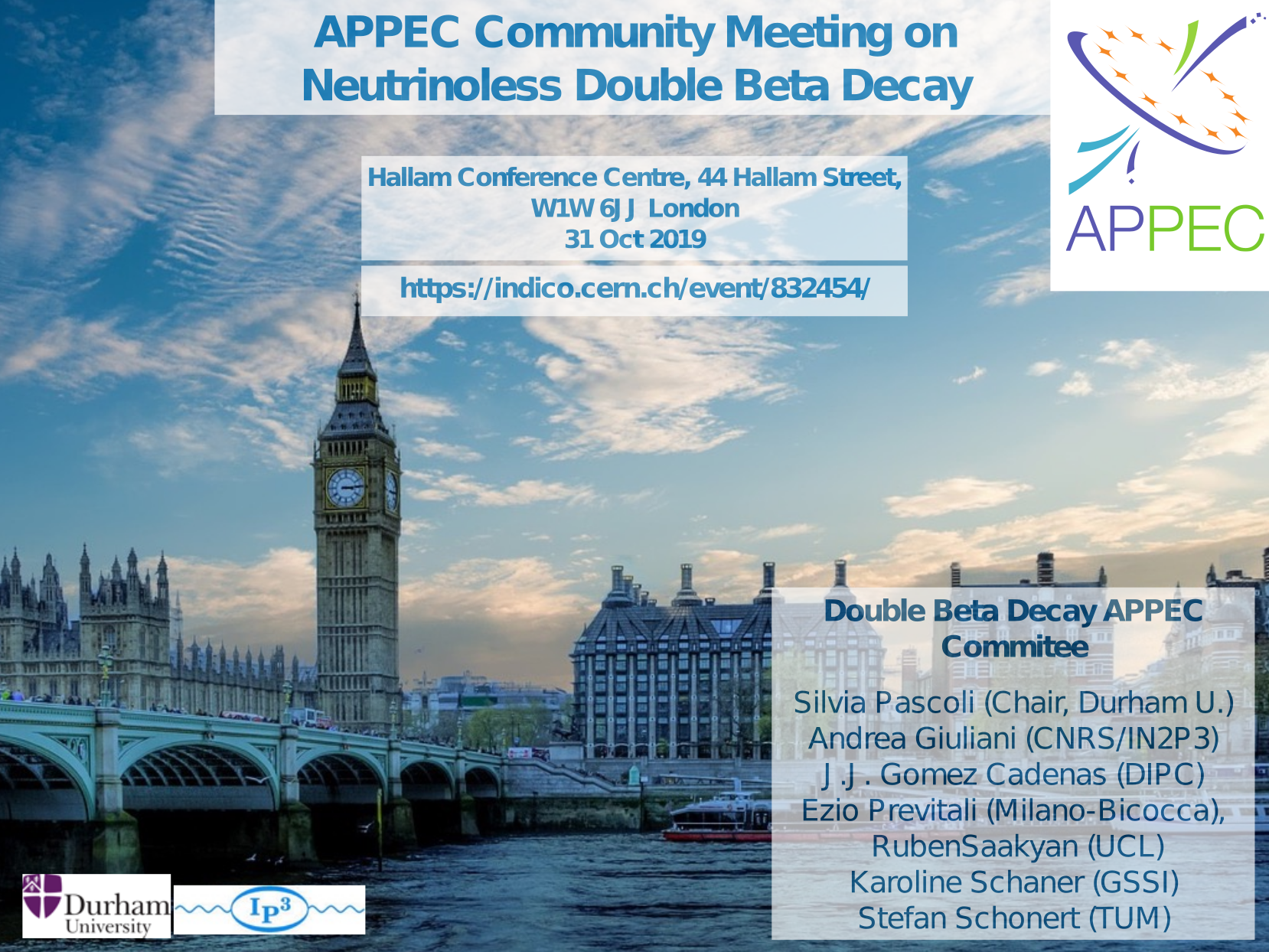
The APPEC Community Meeting on Neutrinoless Double Beta Decay will take place on 31 October 2019 at the Hallam Conference Centre, London, UK.
This meeting aims at discussing and collecting the input of the community on the roadmap document (to follow) prepared by the Double Beta Decay APPEC Committee for the APPEC SAC on the future neutrinoless double beta decay experimental programme in Europe. The ultimate goal is to maintain a leading role in this scientifically important quest, in line with APPEC Roadmap recommendations. We will assess the existing, planned and proposed technologies, their discovery potential and technical challenges, making a critical examination of resources and schedules. We will also review the theoretical issues and the status and uncertainties on the nuclear matrix element evaluation.
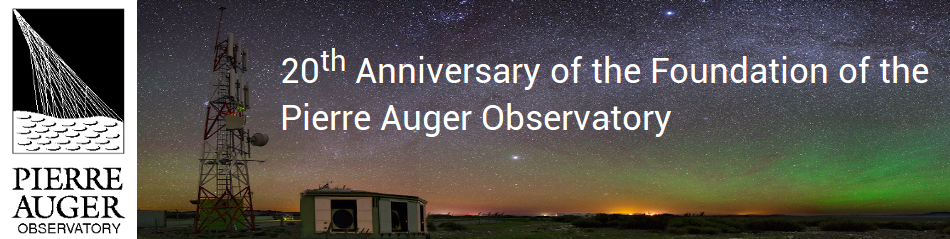
The Pierre Auger Observatory is the world-wide largest cosmic ray detector, covering an area of 3000 km2. It is operated by a collaboration of more than 400 scientists from 17 countries. The aim of the Observatory is the study of the highest-energy particles of the cosmos, up to 1020 electronvolts and above. Data of the Auger Observatory led to major advances in our understanding of high-energy phenomena linked to the most violent processes in the Universe. Scientific breakthroughs have been achieved in several fields. Still, the sources of the particles of such extreme energies have not been identified. In addition, the properties of multiparticle production are studied at energies not covered by man-made accelerators searching for new or unexpected changes of hadronic interactions. The currently ongoing upgrade of the Pierre Auger Observatory, called AugerPrime, will help to address also those remaining open questions and will favor the emergence of a uniquely consistent picture.
The Scientific Symposium, Science Fair and official Celebration will take place in Malargüe (Province Mendoza, Argentina), at the site of the Pierre Auger Observatory.
The event is organized as follows:
14-15 November:Scientific Symposium focused on UHE cosmic rays, cosmic ray sources and propagation, high-energy neutrinos and gamma rays, hadronic interactions and multi-messenger astronomy, with an overview on the status and perspectives of astroparticle physics. Scientific presentations on the status of the field will be given. In parallel a Science Fair set up in co-operation with local schools will be held at the Auger Assembly Building. The meeting will be concluded with a half-day guided tour to the Observatory to get an insight of the Fluorescence and Surface detectors.
16 November, Saturday:Official Celebration Ceremony to recognize the role of the Pierre Auger Observatory with the participation of national and international VIPs and members of finantial institutions supporting the project.


 The VIth CNRS thematic School of Astroparticle Physics on “PHYSICS and ASTROPHYSICS of COSMIC RAYS” will be held from November 25th – 30th 2019 at the OHP Saint Michel l’Observatoire in France. This school follows several other schools supported / organized by the Programme National Hautes Energies (
 The
The