— CANCELLED/POSTPONED, please check the website of the event for further information —
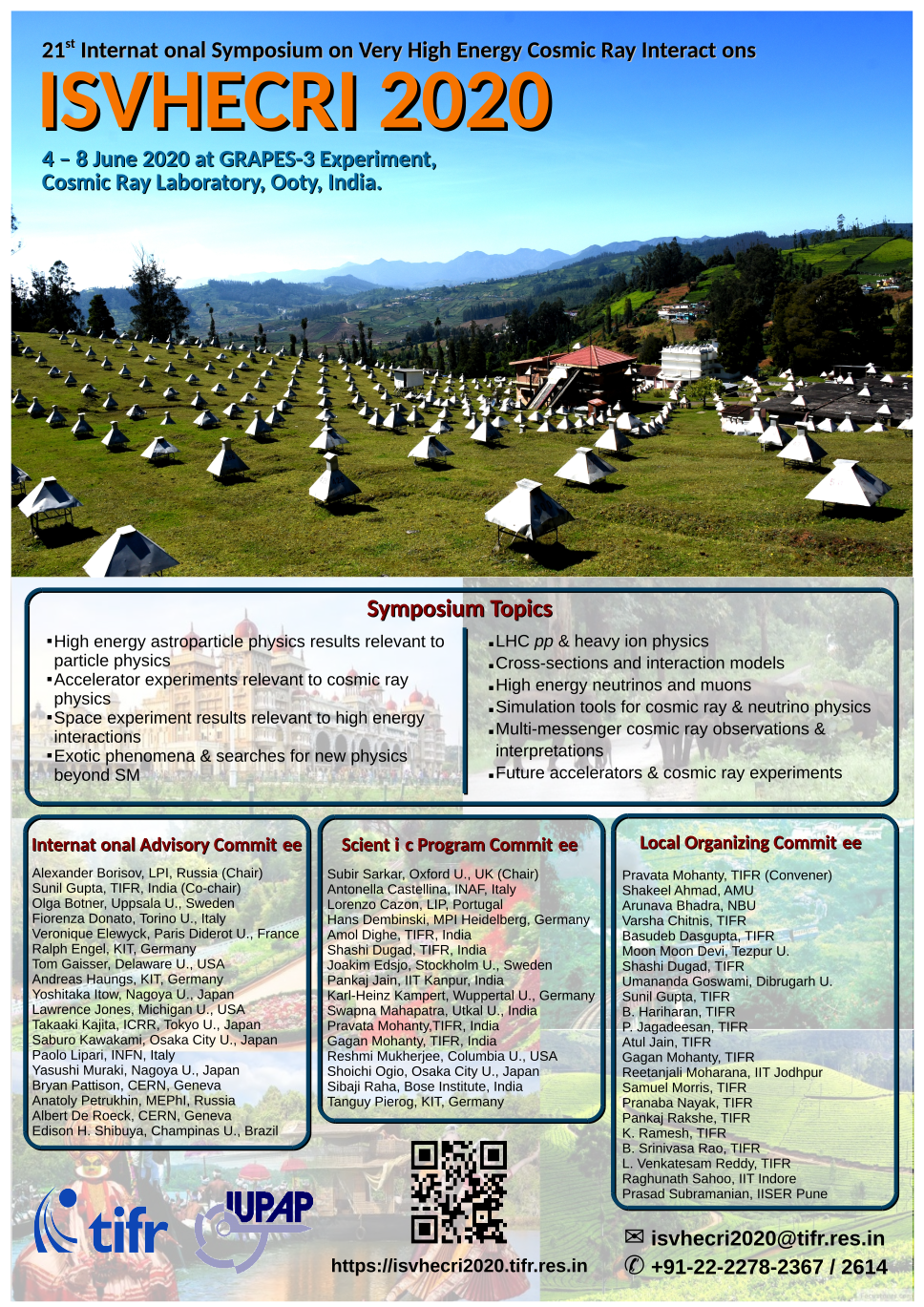
The 21st International Symposium on Very High Energy Cosmic Ray Interactions (ISVHECRI 2020) will be hosted by the Tata Institute of Fundamental Research at the site of the GRAPES-3 experiment in Ooty, India during June 4-8, 2020.
ISVHECRI is a biennial conference series supported by the International Union of Pure and Applied Physics (IUPAP). Its primary objective is to provide a forum for the discussion of very high energy interaction for the interpretation of cosmic ray data based on the information available from both the accelerator and cosmic ray experiments. This unique series brings together cosmic ray physicists and scientists involved with the high energy accelerators and colliding beam facilities.
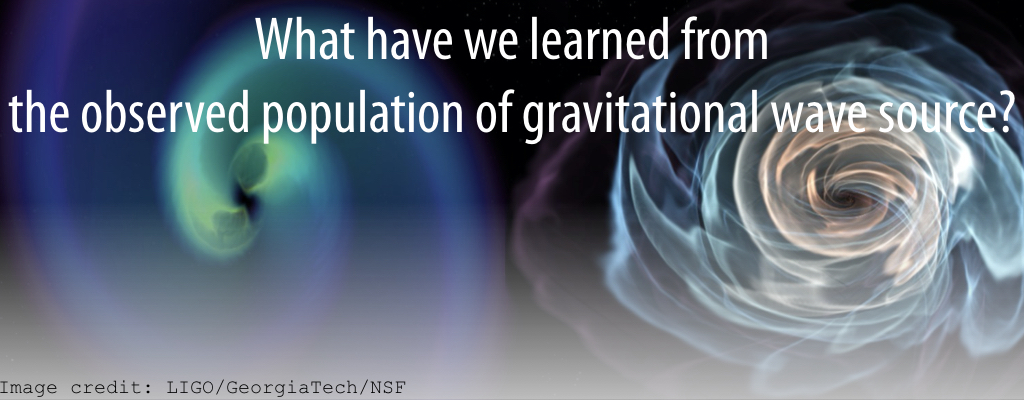
The EAS S5 symposium on gravitational-wave astrophysics will take place during the virtual European Astronomical Society (EAS) annual meeting on the 2nd and 3rd of July 2020 and focus on the question of “What have we learned from the observed population of gravitational wave sources?”.
In this symposium, it will be discussed what have we learned so far from the observed population of gravitational-wave sources and what are the implications regarding the stellar progenitors of gravitational-wave sources, kilonovae and more generally electromagnetic transients that accompany gravitational-wave events, nucleosynthesis, general relativity and nuclear physics.
— CANCELLED/POSTPONED, please check the website of the event for further information —
The DarkMachines workshop: “Advanced workshop on Accelerating the Search for Dark Matter with Machine Learning” will take place from 27 April to 1 May 2020 at CERN. This workshop is the third edition of a series of yearly meetings of the Dark Machines community (http://darkmachines.org/), a research collective of physicists and data scientists. The aim of the workshop is to answer cutting edge questions about dark matter with the most advanced techniques that data science provides us with. The researchers coming to this workshop will bring together expertise in particle physics, astrophysics, cosmology, statistics and information science (machine learning) and plenty of time will be devoted to discussions and brainstorming.
— CANCELLED/POSTPONED, please check the website of the event for further information —
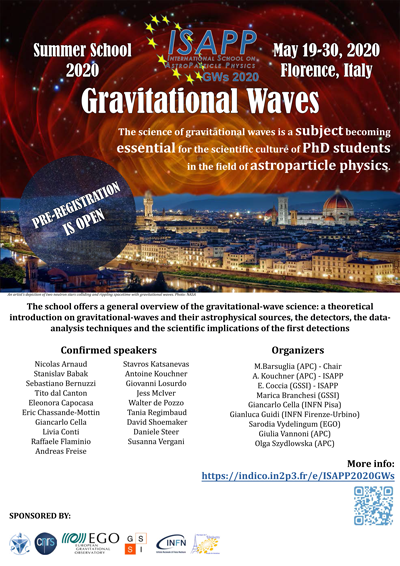
The ISAPP School on gravitational waves will take place from May 19th to May 30th at the Villa Finaly, Florence.
The science of gravitational waves is becoming an essential part of the scientific education of PhD students in the field of astroparticle physics. This school offers a general overview of the different aspects of this science: a theoretical introduction on gravitational waves and their astrophysical sources, a course on detectors, and finally an overview of data analysis techniques and the scientific implications of the first detections. Future perspectives, covering the instruments and associated science, will also be discussed.
The school will take place in Villa Finaly, an historical place belonging to the Paris Universities. This quiet location, offers the possibility of in-depth discussions among students and between students and teachers, who are encouraged to stay as much as possible.
Lectures will take place in the morning and early afternoon. Then Q/A sessions or time for projects development are allocated in the afternoon. Projects (for example, analysis of LIGO and Virgo data) will be developed in groups, with a kick-off at the beginning of the school and a final presentation at the end of the school.
In the evening, informal meetings are planned on broader themes, such as the challenges of open data, the management of a large science project, and how to perform high quality science outreach.
— CANCELLED/POSTPONED, please check the website of the event for further information —
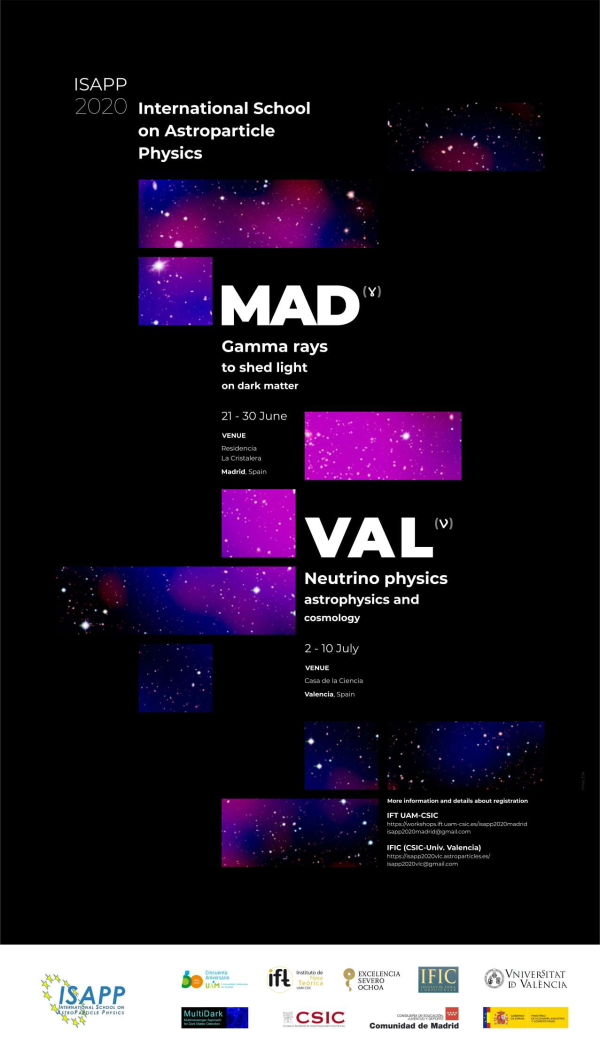
The ISAPP school on “Gamma rays to shed light on dark matter” will happen in Madrid between 21-30 June, 2020.
The purpose of the School is to offer a general overview of the state-of-the-art of gamma-ray dark matter searches and it is primarily aimed at students at the MSc and PhD level, as well as young postdocs working in the field.
Being an ISAPP school, it will closely follow the same format and spirit of previous ISAPP schools across the world.
The program will include introductory lectures on Astrophysics, Cosmology and Particle physics, as well as a series of more specific lectures on each of the main topics. It will also provide the students with some of the most useful computational tools in the field, by running a few hands-on sessions on specific yet quite standard dark matter work packages.
— CANCELLED/POSTPONED, please check the website of the event for further information —
The ISAPP summer school on “Neutrino Physics, Astrophysics and Cosmology” will be held at the Casa de la Ciencia in the historic centre of Valencia (Spain) from 2-10 July 2020. The school’s goal is to cover the main theoretical and experimental aspects of neutrino physics. The school is primarily aimed at PhD students and other young researchers working in this field, either experimentalists, theorists or phenomenologists who wish to have an up-to-date overview of neutrino physics and its connection to Astrophysics and Cosmology.
Following the standard ISAPP school format, the scientific program will consist of main lectures (1.5 hours including discussion) including introductory pre-courses on Particle Physics and Cosmology. Some sessions will be devoted to discussions to stimulate the interaction among students and lecturers. There will be also poster presentations for which participants are encouraged to contribute with results on their current research topics.
The 4th Workshop of Big Data Science in Astroparticle Physics – Deep Learning & Open Data – will take place from 17 -19 February 2020 in Aachen, Germany. The workshop covers the following topics:
Hands-on tutorials
Deep Learning
Open Data-Software-Analysis
Actual developments
For those who never worked with deep network there is the possibility to participate in a beginners tutorial on Deep Learning.
This workshop is supported by Helmholtz Alliance for Astroparticle Physics HAP and Arbeitskreis Physik, moderne Informationstechnologie und Künstliche Intelligenz der Deutschen Physikalischen Gesellschaft e. V. AKPIK.
— CANCELLED/POSTPONED, please check the website of the event for further information —
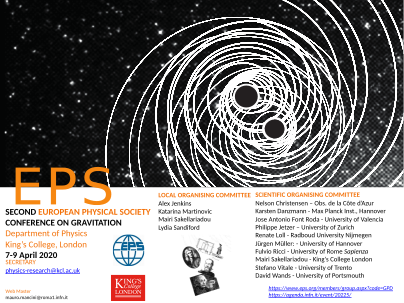
The second EPS (European Physical Society) Conference on Gravitation is held at King’s College (London, UK) from April 7th to April 9th, 2020. The aim of the conference is to discuss experimental aspects of Gravity, including General Relativity tests, measurements of the G constant, Geodesy, and Gravitational Waves.
The conference is organized in days focused around key topics introduced by invited speakers and followed by contributed talks. There will also be a poster session, together with four Young Scientist Awards to the best poster contributions by skilled young researchers .
Early registration ends 1st March, 2020 and abstract submission ends 2nd February, 2020.
— CANCELLED/POSTPONED, please check the website of the event for further information —
The first Pollica Summer Workshop on Dark Matter aims to bring together the world’s leading experts, both from theory and experiment, working on a broad range of ideas, existing and proposed experiments. This workshop, which will take place in the beautiful setting of the medieval town of Pollica in the Cilento region in Italy is an opportunity to galvanize theoretical efforts in a period where new experiments come online and the particle physics community must think broadly about new frontiers ahead. This is an exciting time to connect fundamental physics to the upcoming experimental landscape. The workshop is scheduled for the dates of 15-26 June 2020 and will be hosted in the 14th century Castello Dei Principi Capano.
The deadline for applications is January 31st 2020.
In light of the present COVID-19 worldwide crisis and after carefully considering all options, it has been decided that Neutrino 2020 will be held as an online-only conference. It is assumed that it will take place on or close to the originally planned dates and it is expect that there will be a process for online poster presentation. More details on the conference format will be announced on the conference website.
The XIX International Conference on Neutrino Physics and Astrophysics will be held June 21 to 27, 2020, in Chicago, Illinois. Its primary focus is to review the current status of neutrino physics, the impact of neutrino physics on astronomy and cosmology, and the vision for the future development of these fields. The conference consists of invited plenary talks and contributed poster sessions.


 The 4th Workshop of Big Data Science in Astroparticle Physics – Deep Learning & Open Data – will take place from 17 -19 February 2020 in Aachen, Germany. The workshop covers the following topics: